My 3rd round of chemo started with an infusion yesterday. For the first few days of a new round, I’m on some extra medication that counteracts some of the negative side-effects of the chemo agents. So while I’m on those medications, I’m actually feeling really good! Those medications will run out on Sunday, so starting Monday is when I start “Fatigue Week”, which for me has been just sleepiness. Until then, I’m actually feeling good and can do my normal 2 short walks a day, and even do my stair exercises. “Fatigue Week” has generally lasted just from Monday to Thursday or so, and then I’ve been turning a corner on Friday, which I expect to happen this week as well.
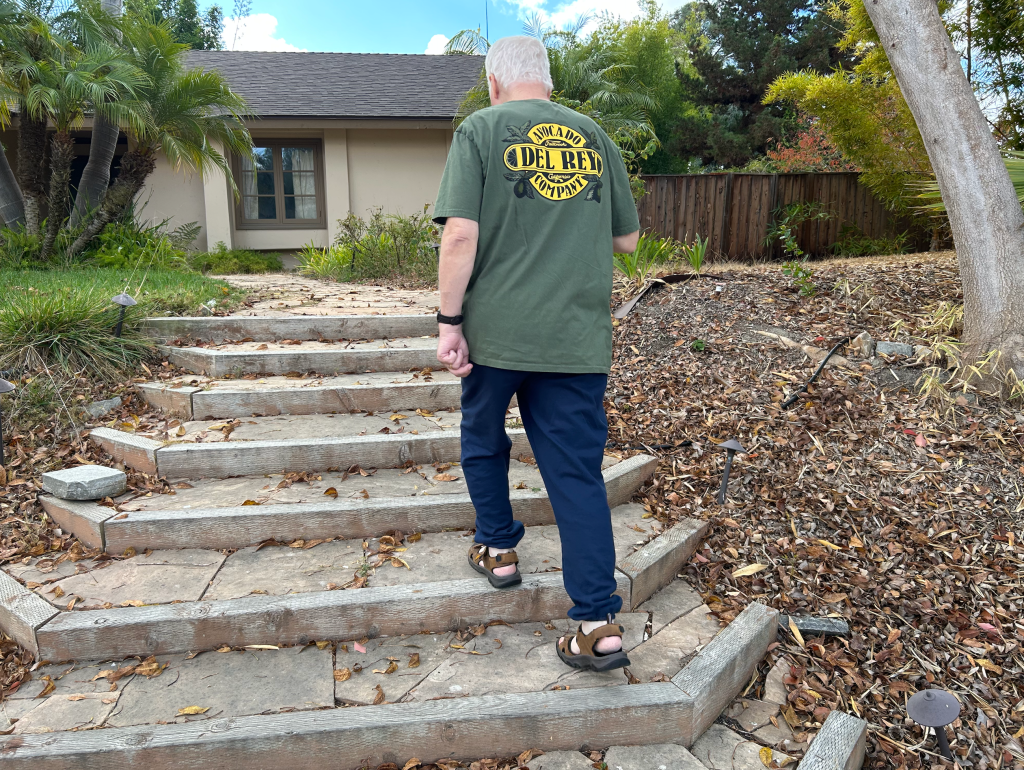
I usually go on 2 short walks a day. Then I do 5 sets of stairs after my walk, trying to regain muscle mass after my long hospital stay. It’s already making a difference!
I caught a very mild viral infection this time, and had to be more strict on having visitors. Fewer visitors, and always meeting out on the patio from now on. Despite that, my White Blood Cell count remained fine for a person on chemo, so my 3rd round started on time. I also finished my radiation treatments on Friday, November 8th, so I’m very happy to be done with that. Now it’s just chemo, and immunotherapy starting with my next chemo round in early December. People tolerate immunotherapy very well.
Because I’m halfway through chemo, Kathy remarked that it felt like “Wednesday”, like we just have to endure a few more days before the welcome end. Everyone from students to adults in the workplace know what that feels like!
Right now, I’m thinking as if my chemo journey will end around December 14th, when I’ll emerge from my “bad week” for that round. Then I’ll need to start working out, regaining the strength I lost while in the hospital. It’ll take me a few months to get back to my ideal weight, and be ready to travel again. So by Christmastime, I should be mostly back to normal.
Results continue to be very good, and my prognosis remains very good!
Thanks again for all your prayers! We continue to pray that my tumor tissue will become lung tissue, and not just scar tissue, to maximize my hiking, backpacking and skiing abilities, some of my favorite activities!
Also pray that my broken rib will heal quickly! We still have no idea how long it will take, but it will be much longer than the usual 6 weeks, since the pieces are not sitting right next to each other yet, but have to grow together before they can mend.
Don’t fear, but be smart, Erik
If you want to subscribe to these posts, click on the “Subscribe” link on the lower right corner of this page. The link will also appear if you start scrolling up from somewhere in the middle of the page.
I’m going to share a brief update, and then give you some information on how my treatments work! In my private discussions with some of you, there is some curiosity about radiation, chemo, and the immunotherapy that I’m using to get well. So I thought I’d give some details on those things.
I also want to say before I start, that I’ve also learned from several of you that you are going through your own journeys with major health problems right now, including cancer. Know that I am praying for you! May God take care of you just as He has been taking care of me!
Update: My first infusion was October 3rd. The nurse told us that the worst days were 4-10 days after infusion and she was right! I was miserable and wiped out the following Tuesday!
I’m doing much better now, and enjoying the break. My next infusion is this week, on the 24th. I’m half way done with radiation treatments on my primary tumor, and my last radiation is on November 8th. So my last 2 infusions will happen after radiation is over. So this next one will likely be the worst, but the last 2 infusions are likely to be easier than the first 2!
My last infusion is on December 5th, and I’m looking forward to feeling much better in December. Hopefully by Christmas, I’ll basically be back to normal.
My pain is low enough now that I’ve started to work myself down from the opioids, which is lowering some of the negative side effects from an already low dose. The doctors are pleased at this news! I’m also able to eat more, so I’m working on gaining some weight.
We are so thankful for the support of friends and neighbors that we continue to get. Your prayers have been an important part of my progress, so keep it up!
Radiation: Radiation is a common cancer treatment because it’s less invasive than surgery, but it’s still quite effective at killing cancer cells. It works by damaging the DNA of cancer cells, leading to the self-destruction of the cells.
X-ray radiation is the most common. An emitter looks like a giant microscope and moves around the patient, firing hundreds of X-ray beams in sub-lethal doses. Only the tumor receives a lethal dose of X-rays. The CT scan measurements are exact and treatment plans are done by a physicist for each patient. In fact, a physicist and doctor need to be present and approve how the machine is lined up with the tumor every day before they start the radiation treatment!
An X-ray therapy instrument. The large piece with a glass pane right behind the patient’s head is a CT machine that does a mini-scan every time I go in, to make sure that my body is properly aligned with the map that they have. The gray plate on the right detects the x-rays from the CT machine after they go through the patient.
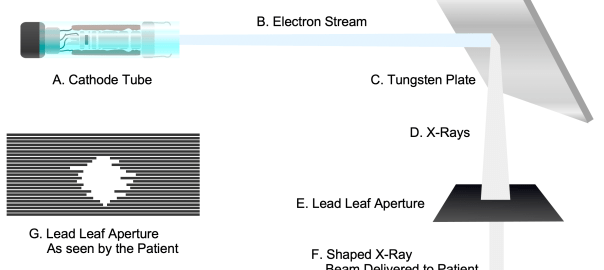
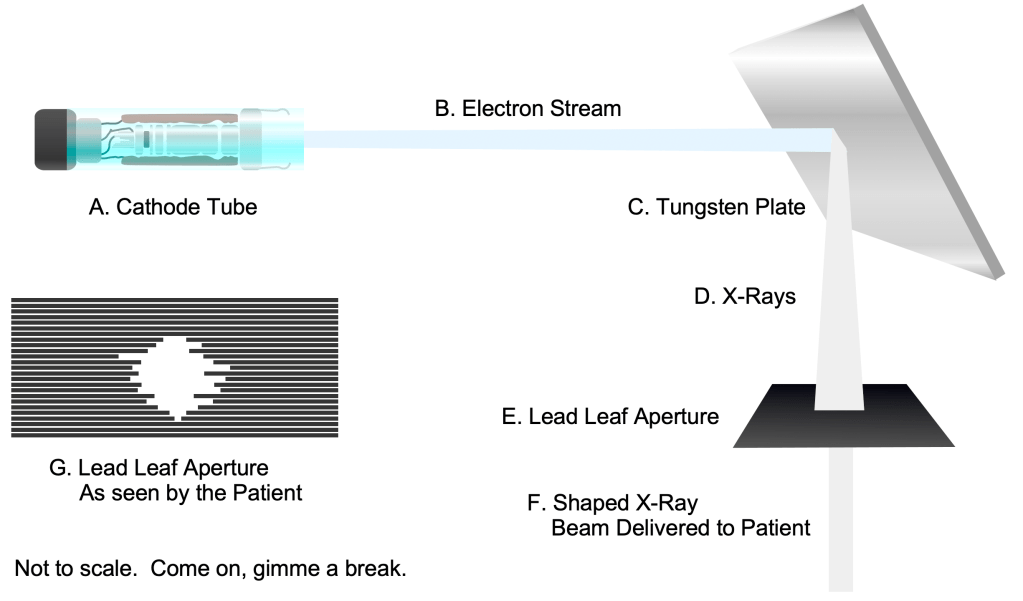
Inside the instrument, an electron beam is created by a cathode ray tube, much like the ones that used to be in the old tube televisions. The electron beam strikes a tungsten plate The electron beam is absorbed by the plate and transformed into X-rays that are emitted by the tungsten plate. These X-rays then pass through a lead aperture that shapes the beam into just the right configuration for the shape of the tumor at that angle. This aperture is made of lead “leaves” that actually move to shape the beam as the emitter moves around the patient. Yes, I can actually see the aperture changing shape as the emitter moves around me!
Inside the instrument, an electron beam (B) is created by a cathode ray tube (A), much like the ones that used to be in the old tube televisions. The electron beam strikes a tungsten plate (C). The electron beam is absorbed by the plate and transformed into X-rays (D) that are emitted by the tungsten plate.
These X-rays then pass through a lead aperture (E) that shapes the beam into just the right configuration (F) for the shape for the tumor at that angle. This aperture is made of lead “leaves” (G) that actually move to shape the beam as the emitter moves around the patient.
Yes, there is a risk that the X-rays themselves will cause a new cancer tumor to form, but the likelihood is that if one does, it will take many years for the new tumor to cause a problem, after the patient will have passed away from natural causes.
Proton beam radiation is much less common and much more expensive than X-ray treatment. Protons can more easily be concentrated on the tumor and are less likely to cause a new tumor. For these reasons, proton therapy is more commonly used on younger patients, to avoid the likelihood of producing a new tumor within the patient’s lifetime.
Chemotherapy: Normal human cells have many molecular checks to their growth, making sure the cells don’t get out of control. Cancer cells have mutations that turn off these checkpoints. This is why cancer cells grow rapidly and can become dangerous. Chemotherapy agents selectively kill cells that are growing rapidly. Since cancer cells are growing very rapidly, chemotherapy agents kill them first. Unfortunately, some normal cells in the body grow faster than others, like hair, gut, and blood cells. This is why patients can lose hair, experience nausea and digestive problems, and suffer from low blood cell counts, or even become immunocompromised.
The good news is, on balance, chemotherapy is usually very effective at killing cancer cells, and many people have been saved through the use of these agents.
As I said in my first 1st update, Next Generation Sequencing (NGS) testing can help doctors know if a patient will need to use certain chemotherapy agents. My tumors don’t happen to be particularly interesting in this regard, so I’m just getting a “normal” first try set of chemotherapy agents. NGS has definitely increased the survivability of cancer by helping chemotherapy work on the first try!
Immunotherapy: The PD-1 protein exists on the surface of certain T and B cells of the immune system. They work to inhibit the function of these cells in most conditions, making them tolerate “self” cells in the human body, helping to prevent autoimmunity. If a person has cancer, “turning off” these proteins can make these T and B cells no longer recognize cancer cells as “self”, and attack them! Immunotherapy agents like Keytruda inhibit the PD-1 protein, causing the immune system to attack some tumor types, like the cancer I have, non-small cell lung cancer.
Prayerrequests: I’m doing much better eating, and my goal is to maintain my weight through the next round of chemo, and to gain some after that. Pray that I will be able to eat enough calories for that! Thanks!
Don’t fear, but be smart! Erik
If you want to subscribe to these posts, click on the “Subscribe” link on the lower right corner of this page. The link will also appear if you start scrolling up from somewhere in the middle of the page.
I came home from the hospital on September 15. It’s been great to be home! My focus has mostly been on healing, following directions, and getting ready for my chemotherapy sessions to start. An ongoing issue has been that I lost weight in the hospital, which I should try and get back before chemo.
So I’ve been exercising as much as I can, going for short walks, and doing limited workouts in my chair.
Chemo I had my first chemo session on Thursday, October 3, on schedule. The infusion took about 2 hours, and everything went fine. I’ll have 4 sessions total, each 3 weeks apart, the last one taking place on December 5th.
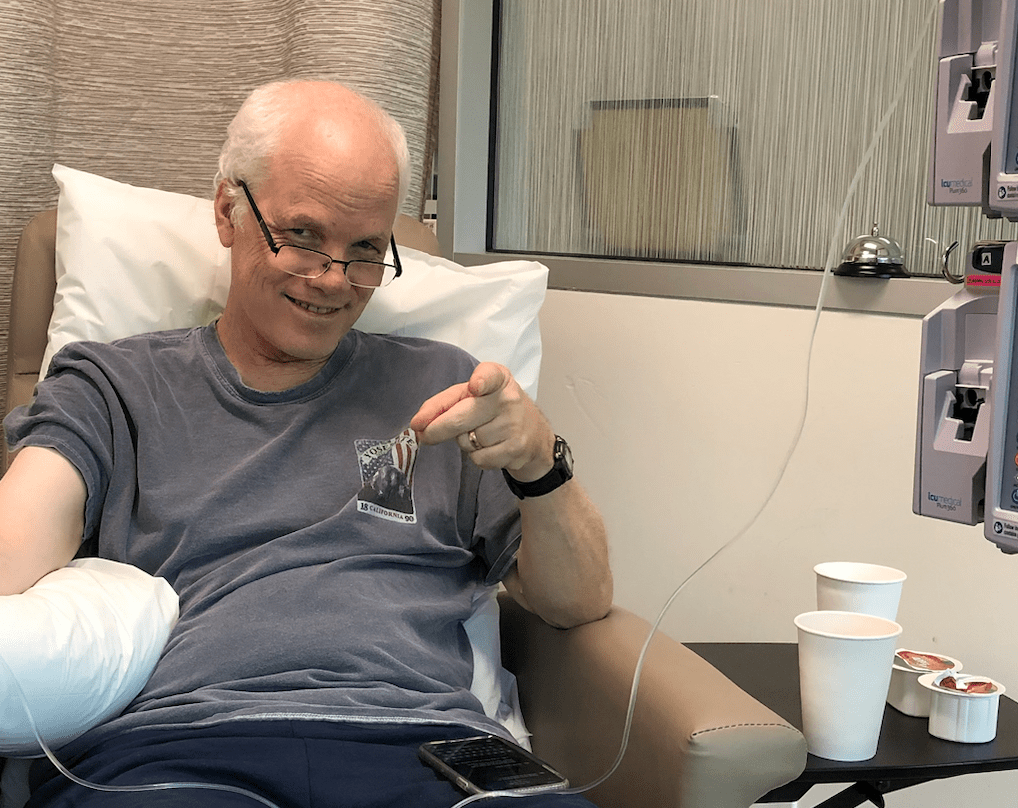
My first infusion. Yes, I’m saying “Let’s do lunch!”
Tumors Shrinking! Thursday was a very busy day. After my chemo session, I actually had a late radiation session and a meeting with my radiation oncologist. He told me that my tumors, both of them, were shrinking faster than anticipated. Yes, both of them! Even before chemo, he noticed that my primary tumor in my lung was shrinking as well. It was shrinking about 3 times as fast as normal. My doctor said “I can’t really explain such a change.” He seemed quite pleasantly surprised, and baffled at the some time.
Abscopal Effect? If anything, he said he might attribute this to a phenomenon called the Abscopal Effect. Basically, debris that is formed as the rib tumor starts to fall apart due to the first set of radiation treatments end up becoming material that the immune system uses to mount a defense against the second tumor. The radiation starts killing the rib tumor, creating a vaccine that tells the immune system how to attack the primary tumor! Just to emphasize, even to my radiation oncologist, the Abscopal Effect is still theoretical, and is a very rare phenomenon to see.
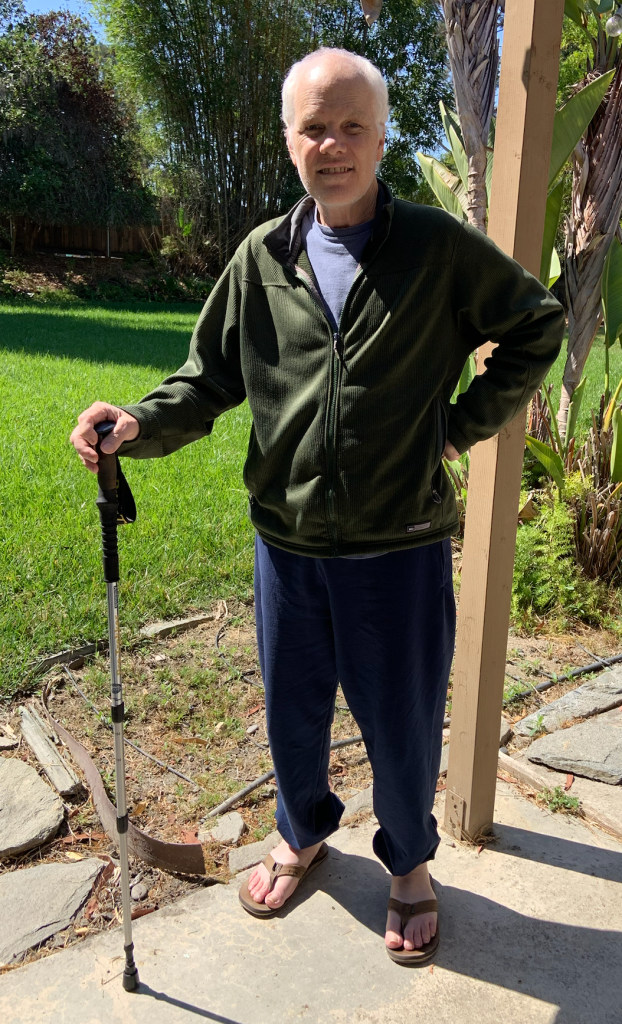
I recently graduated from a walker to a hiking stick.
Today, Monday October 7, before my radiation treatment, they actually did a new mapping scan in order to re-calibrate because of the extra tumor shrinkage.
In short, your prayers are working! Thank you so much for your prayers and keep it up! I actually need extra prayer because chemo is making it hard to keep food down. Hopefully this will just be happening the first week.
Don’t fear, but be smart! Erik
If you want to subscribe to these posts, click on the “Subscribe” link on the lower right corner of this page.
On Sunday, September 15, I got out of Scripps Encinitas Hospital after a 2 week stay. In the next few updates, I’ll tell you what I was doing there and how I’m doing now.
Complications On Sunday, September 1st, I was experiencing a lot of pain, sometimes 8 on a scale of 1-10.
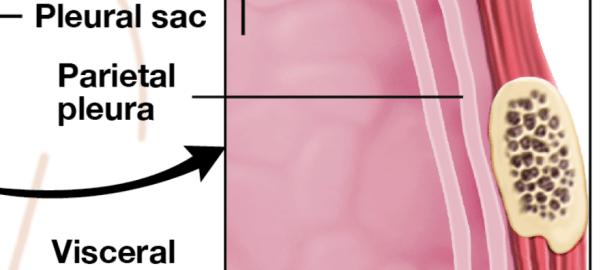
We went to the ER and after some testing, they discovered 2 major complications. 1 was a pleural effusion, a bag of fluid between my lung and chest cavity that was limiting my lung capacity. The pleural cavity is usually a very narrow cavity between the lungs and the rest of the body. Just around the lung is a thin tissue called the parietal pleura. Normally, this cavity contains just enough fluid to allow the lungs to glide along this tissue as they expand and contract. Sometimes, however, this fluid inside this cavity doesn’t drain properly, and fills will fluid. This is a rare condition. The problem with this is that the extra fluid can compress the lung and reduce lung capacity, making it harder to breathe.
They had to install a chest tube so the fluid could drain.
The inside of the lung is actually “outside” the body, because it is open to the outside world. The pleural cavity is just outside the lung. This is the area that can fill with fluid to create an effusion.
Additionally, they found an infection, a bacteria called Granulicatella adiacens, a species that is difficult to grow in a lab, and so unknown even to most microbiologists. The infection was related to the effusion, so the next day, they put in a chest tube so they could drain fluid from the effusion.
So now instead of one potentially deadly condition, I now had 3.
Insurance When Kathy lost her job last year, we lost our traditional health insurance, which was really good. We signed up for a cost sharing program. To use one of these programs, you need to tell medical providers that you are self-pay. You pay everything with cash or credit card. You get an itemized receipt from the provider, then submit to your program. We will get reimbursed by our program roughly 3 months after we pay the expense.
There are big pros and cons to these programs.
Cons:
1. Cost sharing programs are new, so most providers still don’t know how to handle them. They reflexively want to bill insurance, so they are always asking what program we have. To prevent them from sending our program a bill, we always just say that we’re self-pay.
2. It’s almost been a full-time job for Kathy to collect itemized bills from hospitals, individual doctors, and laboratories. Happily, Kathy is running her art business full time now, so she has the flexibility to do this.
Pros:
1. Providers usually give huge discounts for self-pay. My recent hospital stay was expensive, but we will get a 50% discount.
2. The monthly cost of our sharing program is far less than insurance premiums for the both of us for the month. So we actually opted not to get insurance from my new job.
3. One big problem with health care is that you can’t just ask your provider how much something costs. Insurance companies still cut mysterious deals with providers, so no-one seems to know what anything costs. Cost sharing programs may be a way around this. We get bills with actual numbers on them for the services we use.
First world countries have a variety of approaches to health care. Nationalized services have the problems of high taxation and long waits for care. The US now has high costs for insurance premiums and high deductibles. I think cost sharing, when it’s more accepted, may be the future of health care payments.
Opioids I started taking opiate medications, which made me mildly hallucinate and become nervous about addiction.
I’m not at all excited about taking opioids. Coming in several forms, opioids are highly addictive, and have other unfortunate side effects. I’m a very disciplined, type-A person, so I’m hopeful I won’t have too much trouble working my way off of them, but friends who have done so say it took them some time. I also have friends, very good people, who ended up having to go to rehab so they could be supervised. You can certainly pray for me during this process when the time comes.
If you end up having to take opioids, make sure you work with your doctors to find the right regimen, and follow your doctor’s orders. You can change your prescription and orders, but don’t take more than your doctor prescribes. This will help keep you from having trouble.
Erik
If you want to subscribe to these posts, click on the “Subscribe” link on the lower right corner of this page.