Category Archives: Uncategorized

Cancer Update 11: “Friday”

Last week was probably my last hard week after an infusion, as I probably won’t have another chemo infusion!  So to extend my analogy from my “Wednesday” post, it’s now “Friday”!  I should be feeling better from here on out.  My chemo oncologist also said no more immunotherapy until they see the results from my PET scan on December 30th, so I get a nice little Christmas vacation from my immunotherapy too!  My next update will probably be after the 30th, letting you know my PET scan results.

I was pretty sleepy this time, and my fatigue from chemo my have been compounded by the immunotherapy.  There are other potential side effects from immunotherapy, but happily, I didn’t really experience any of those. The sleepiness just lasted a few extra days.

I had an appointment with my physical therapist for the first time in many months.  I had a laundry list of things to work on, and it will take us a while to work through them all.  I lost significant strength and muscle mass while in the hospital, so I worked on a bunch of exercises primarily designed to improve my leg and core strength, and to improve my posture, which has gone funky since my hospital stay. I’ve gotten started on doing my exercises at home and I’m looking forward to improvement.

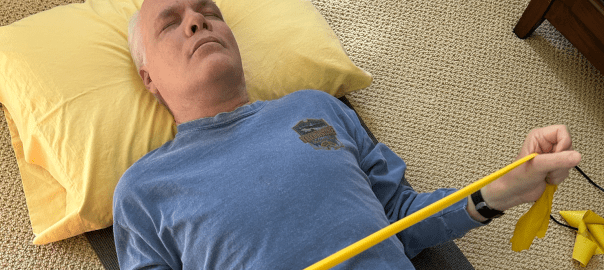
Strengthening my upper back muscles
This looks like a wall sit, but it’s mostly for working on my posture.

Please continue to pray for improved lung capacity.  I’m still short of breath, meaning that my Vital Capacity, the volume of air that I can breathe if I exhale as much as I can, then inhale as much as I can, is still lower than it should be, and I have to take more breaths when I go for a walk.

Don’t fear, but be smart,
Erik

If you want to subscribe to these posts, click on the “Subscribe” link on the lower right corner of this page. The link will also appear if you start scrolling up from somewhere in the middle of the page.

Discourse

This note is on political discussions, but it is neutral in perspective!   I will not advocate for any political worldview in this post.  My goal instead is to help all of us have better discussions regarding politics or anything else. I’m going to share my own method for having productive discussions.

Especially in regard to politics in 2024, the 2 sides have different and mutually exclusive worldviews, different sources of news, different definitions to terms, and even different commonly understood “facts”.  We can’t take anything for granted when having discussions on politics right now.

In my posts on COVID, in my daily life, and even in my recent post on politics, I often employ 2 questions which help me navigate conversations.  These questions are so helpful, I recommend everyone use them in every conversation about important or controversial matters.  These questions are:

1.   What do you mean by that?

2.   How did you come that conclusion?

These questions originally come from a book called Tactics, by Greg Koukl.  This book is intended for use by Christians as a tool to help them discuss the Christian worldview.   I recommend that every Christian read it.  But these questions are so useful, that they can be used when discussing any topic: worldview, politics, science, history, or anything else.  Of course, there are many variations of these questions you can use.  Here’s why these questions are so useful.

1. What do you mean by that?
Many people don’t have a clear understanding of their own view, or topics they are discussing.  It can be very helpful when starting a discussion to make sure everyone is working from the same definition of terms, or the same understanding of an issue. For example, if you are in a discussion and the topic of racism comes up, it might the very helpful to ask your conversation partner what they think racism is. 

This question is also very helpful if you just don’t know very much about the other person’s view.  You can simply use this question to learn about their view.  You can have a very productive discussion just around asking this question and learning their view.

    If things get heated, you can always just go back to asking clarifying questions until things cool down.  Discussions work best when everyone is calm and adrenaline is low!

    The flip side is this.  When going into a conversation on a contentious issue, you should have a firm understanding of your own view, the words you will use, etc.  If your conversation partner asks you this question, you should be able to answer them!

    It’s actually very common in today’s discourse for people to not be able to answer this kind of question.  People often assume that their own view is the commonly held one, only to discover that other people don’t agree.

    2. How did you come to that conclusion?
    It is almost universal that people make a claim in a conversation like this, and then the other person makes a counter claim.  This is actually a bad way to communicate and leads to a lot of misunderstanding and heated rhetoric.  It’s also a lot of extra work.

    If you are having a conversation with someone, and they make a claim, you don’t have to make a counter claim.

    For example:
    Person 1: Trump is a Nazi!
    Person 2: No he isn’t!

    Or

    Person 1: Harris is a commie!
    Person 2: No she isn’t!

    In both examples, Person 1 makes a claim. In this form of discussion, the person who makes the claim bears the responsibility of providing evidence for their claim.  But far too often, Person 2 doesn’t require any evidence and instead does Person 1 a big favor, relieving them of the burden of proof.  By making a counter claim, Person 2 is actually accepting the burden of proof! Now it is Person 2’s responsibility to back their claim!

    Don’t do this!
    Person 1: Trump is a Nazi!
    Person 2: No he isn’t!
    Person 1: How do you know?

    Person 2 has accepted the burden of proof and now must back their counter claim. Don’t do this!  Don’t do the other person’s work for them!  Instead, make the person who made the claim back the claim!

    Do this:
    Person 1: Harris is a commie!
    Person 2: Really? What makes you think that?

    Now Person 1 has to give their reasons why they think Harris is a commie.  In conversations like this, most people don’t actually have evidence for their claim.  If you just ask them to back their claim, they usually can’t.

    Person 2 can save a lot of time and effort by making Person 1 do their own homework. Almost always in today’s dialog, Person 1 can’t back their claim.  This is because most people learn these things from dubious sources, like a friend, the water cooler guy at work, or an obviously biased news program.

    Here’s the flip side.  What if you are Person 1, and you want to make a claim?  Don’t make a claim unless 1 of 2 things is true.  First, you have a good source for your claim. Or second, you are willing to go find the source after the discussion is over.  If this discussion is with someone you see often, it’s no problem to go get the source and then discuss it again.

    Using this question often does 2 things. If you’re Person 1, it will keep you accountable to not make claims you don’t have evidence for!  It’s OK to say nothing in a conversation!  It may be better than to get yourself into a situation in which you or your view look silly.

    Again, it’s OK to make a claim without evidence IF you’re willing to go find it later.  This can open up a chance for another conversation, which may actually work out well for you.

    If you’re Person 2, it saves you A LOT of effort.  You don’t have to work so hard to prove the other person wrong, because you aren’t responsible for the evidence! Of course if Person 1 does have the evidence, then you need to provide your own evidence, or even change your view if it turns out to be wrong!

    Your goal is the truth!
    VERY IMPORTANT! Your goal is not to win an argument! Your goal is actually to arrive at the truth!  If it turns out that your conversation partner has better evidence than you, it may mean that your view is wrong!  It’s obviously OK to abandon your view if it’s not true! 

    I really think that if everyone used these 2 questions all the time, we would have much more productive discussions.  People would be much more careful about the claims they make, and we would waste a lot less time on fruitless and rancorous discussions. You can start using them now, and train your friends bring receipts to your next discussion. You’ll be having more productive and less heated discussions in no time!

    Don’t fear, but be smart,
    Erik

    For more on being persuasive, see my COVID era post on science communication.
    Case Update, March 17th, 2021; Still higher new case numbers than Wave 1?

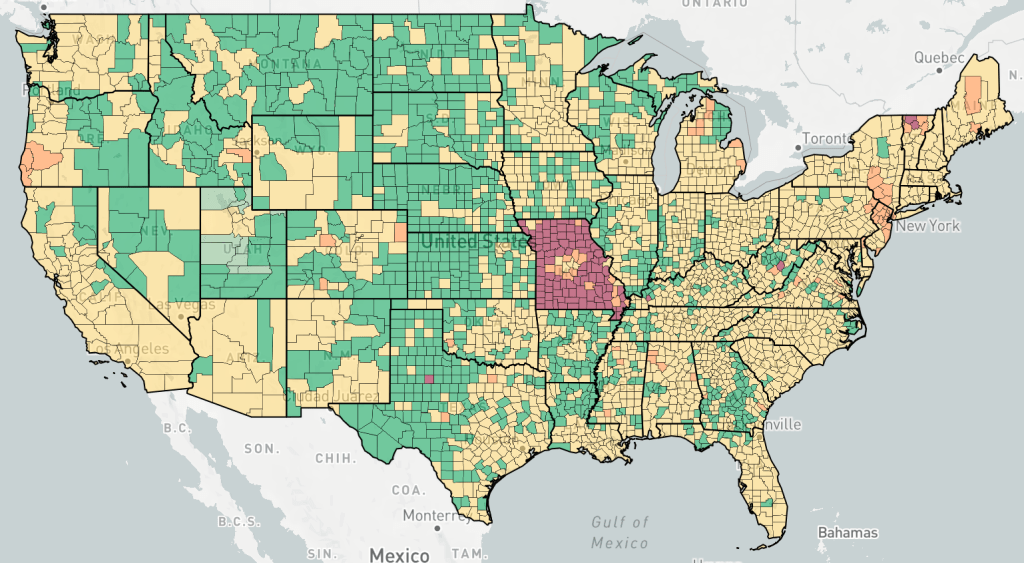
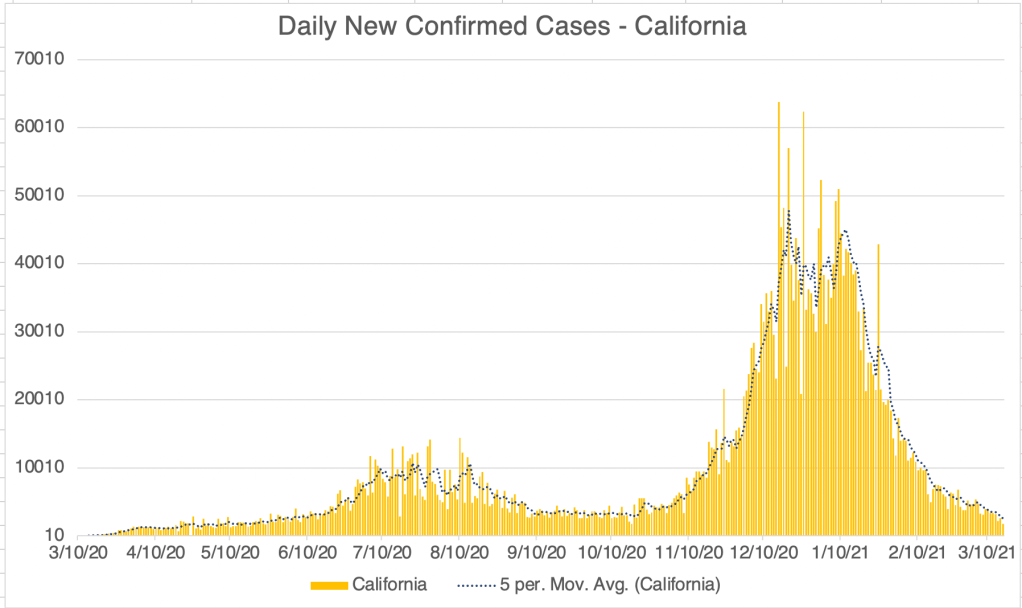
    This is a case update. New cases continue to fall for the US, California, and San Diego. There was a spike in cases for the US on March 8th. At the same time, there is a spike in cases in most counties in Missouri. The spike was so consistent across the state, and stops on every nearby state line, that my suspicion is that this represents a reporting problem rather than actual new cases in every county in the state. Sometimes labs or public health departments don’t report on time and allow new case reports to stack up. When they finally report the results, it looks like a big outbreak. I can’t prove that this happened in Missouri, but it’s my suspicion. I couldn’t find any news about this phenomena, and the Missouri state health department shows no spike in cases during this time.

    Graph is by me, from data collected from Johns Hopkins University COVID site.
    Endcoronavirus County Level Map, March 16th, 2021
    Endcoronavirus State Level Data, March 17th, 2021.

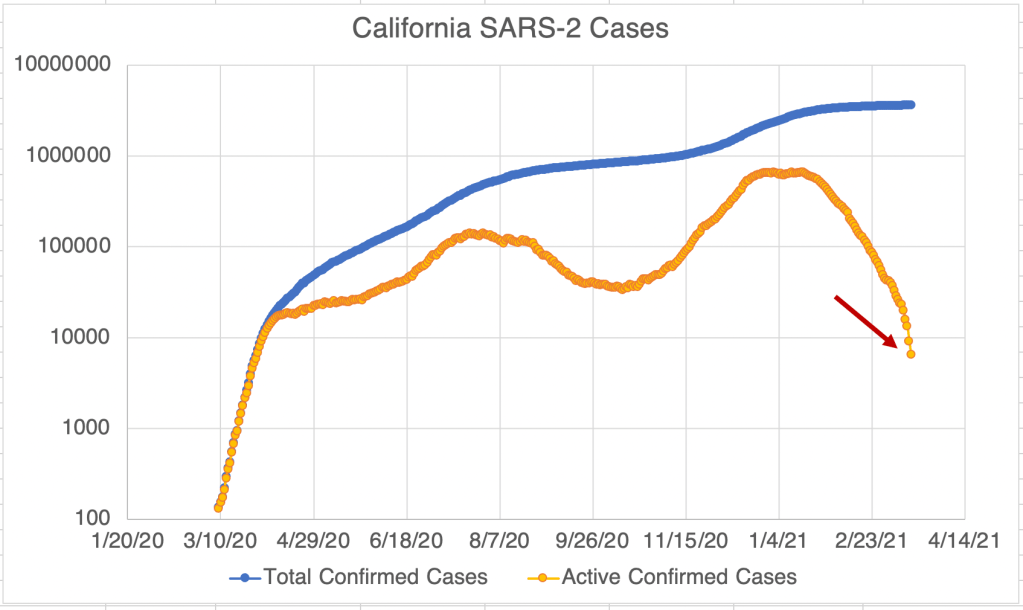
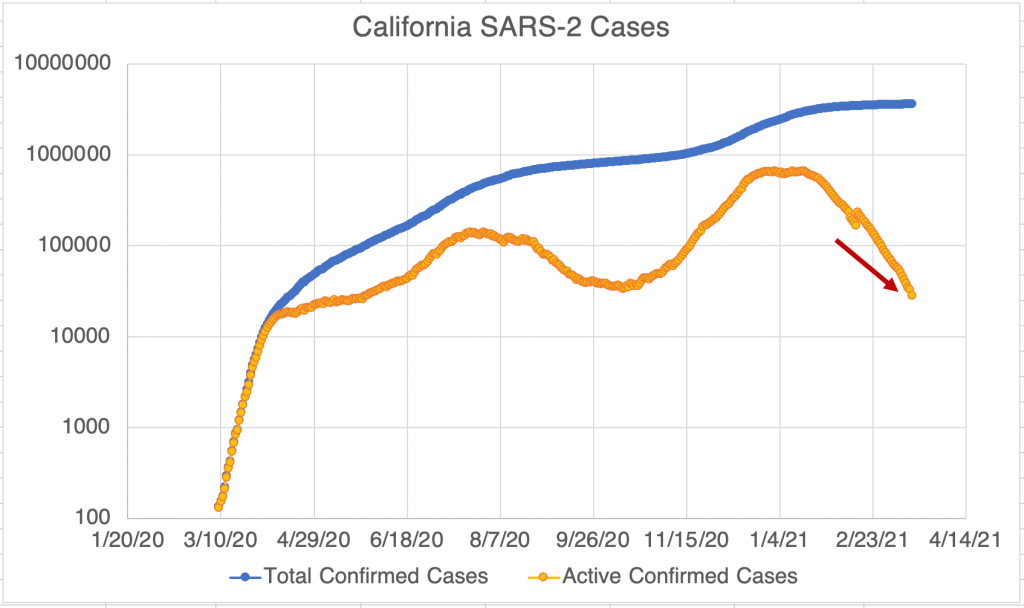
    My total case number graph for California assumes that patients recover after 17 days. But today’s number gives a unbelievably low 6500 active cases in California. California doesn’t report recovered cases, so I’ve been using San Diego Counties numbers and extrapolating an estimate for California. Right now, San Diego’s reported recovered numbers suggests a 22 day recovery time instead of 17. If you use 22 days for California, current active cases for California is 28,000. This is why I tell you exactly how I get my information, so if it’s wrong or suspicious, you can decide for yourself if you believe my source.

    Graph is by me, from data collected from Johns Hopkins University COVID site.
    Graph is by me, from data collected from Johns Hopkins University COVID site. “Active Confirmed Cases” numbers are calculated based on the assumption that patients confirmed to have SARS-2 virus at least 17 days ago have recovered. Given this criteria, the active cases are crazy low right now, probably too low to be real.
    Graph is by me, from data collected from Johns Hopkins University COVID site. “Active Confirmed Cases” numbers are calculated based on the assumption that patients confirmed to have SARS-2 virus at least 17 days ago have recovered. If I change this assumption to 22 days for the last few weeks, matching the estimate from San Diego County, active cases in California is 28,000.
    Graph is by me, from data collected from San Diego County Public Health. See also regularly updated slides from SD County.
    Graph is by me, from data collected from San Diego County Public Health. See also regularly updated slides from SD County. “Active Confirmed Cases” numbers are reported by San Diego County. Because our new active case numbers are getting low, I’ve switched to a logarithmic view. This emphasizes small values and makes them easier to see. Notice that the case number on the left now go up 10 fold with each higher line on the graph.

    Still more than in Wave 1? For the last few weeks, I’ve been saying that while our numbers are getting really low, the numbers are still higher than in Wave 1 from last April. A friend pointed out that last Spring we weren’t really testing much, so maybe the cases were higher. That’s an excellent point and absolutely true. In fact I have several friends that were really sick during the Winter of 19/20, some after spending time with friends or family from Asia. So yes, there may have been far more cases last Spring than we know.

    Don’t fear, but be smart,
    Erik

    Case Update: April 13th

    Originally posted April 13th, 2020, on Facebook

    Friends!

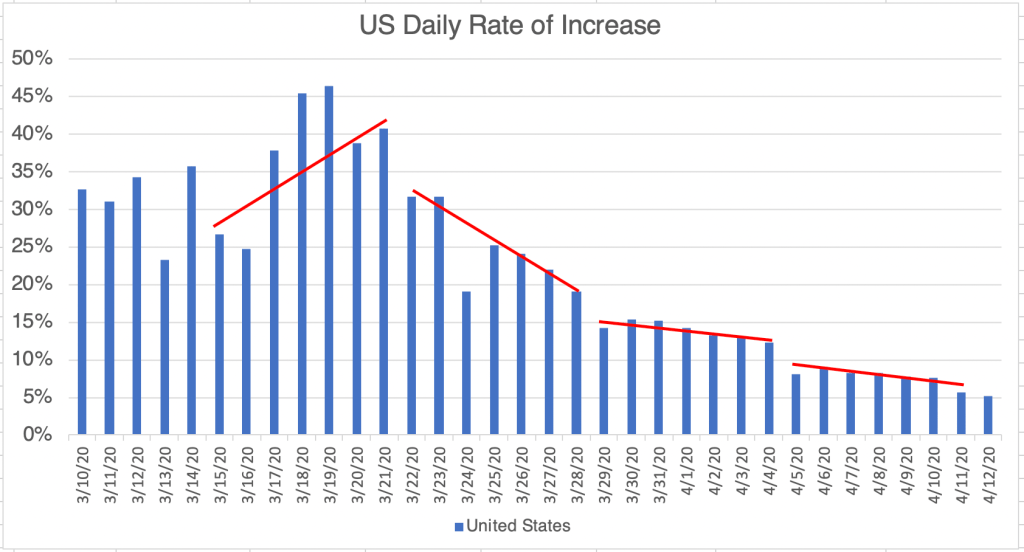
    I have another good news/bad news post for you today. First the good news. Yesterday, 8pm on April 12th, the rate of new infections for the world, the US, California, and San Diego County, were all below 5%! Our efforts are paying off!

    Some of you may wonder if this is a Sunday Effect, a lowering of new case numbers just because it’s a Sunday, and there may fewer people performing tests that day. While it’s certainly true that there have been fewer new cases on Sunday, I noticed that in past weeks, a Sunday drop has often been followed by a lower rate for the entire next week. Last week for example, the rate was below 10% on Sunday, a big drop, but remained low for the entire next week. If this trend holds, then we may have rates near 5% for the entire next week.

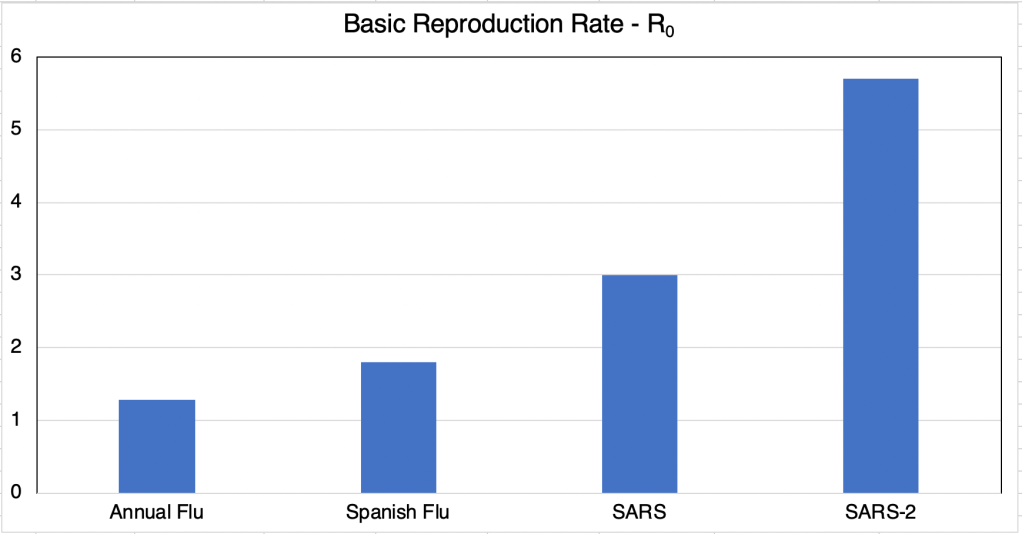
    The bad news isn’t really new, but rather a new study of the Basic Reproductive Number (R0). This number is a measure of infectiousness and is an attempt to calculate the average number of people that an infected person will pass the virus to. For a typical flu, this number is 1.28. For the first SARS virus in 2002, it was around 3. As recently revealed in a pre-publication paper [Sanche et al. High Contagiousness and Rapid Spread of Severe Acute Respiratory Syndrome Coronavirus 2. July 2020, pre-print captured April 13th, 2020. Em. Inf. Dis. 6(7)], the actual R0 value is 5.7, twice as high as originally thought, and 4.5 times more infectious than the typical flu.

    Early on, there was a lot of discussion on whether this virus was spread by droplet transmission (coughing and sneezing) or by aerosol transmission (singing, laughing, shouting, even just talking). The new paper, along with several stories in the news, suggests that SARS-2 is indeed spread at least to some degree by aerosol transmission.

    So here’s the take away from this post. We are doing better, but we’ll have to be very careful how we “go back to normal”. The virus has the potential of springing back to life if we just go back to normal right away. If people are to go back to work anytime in the next few weeks, we will need to remain diligent, yes, possibly wearing masks at work, and do wider spread testing to find infected people. Stay tuned on this evolving situation!

    Don’t fear, but be smart!
    Erik

    PS Pre-published journal articles have not yet received final approval and may change before publication!