Category Archives: All Articles

Re-opening, How Many New Cases?, endcorona.org Compares Responses, Viral Spread

I have a variety of resources to share with you today. 

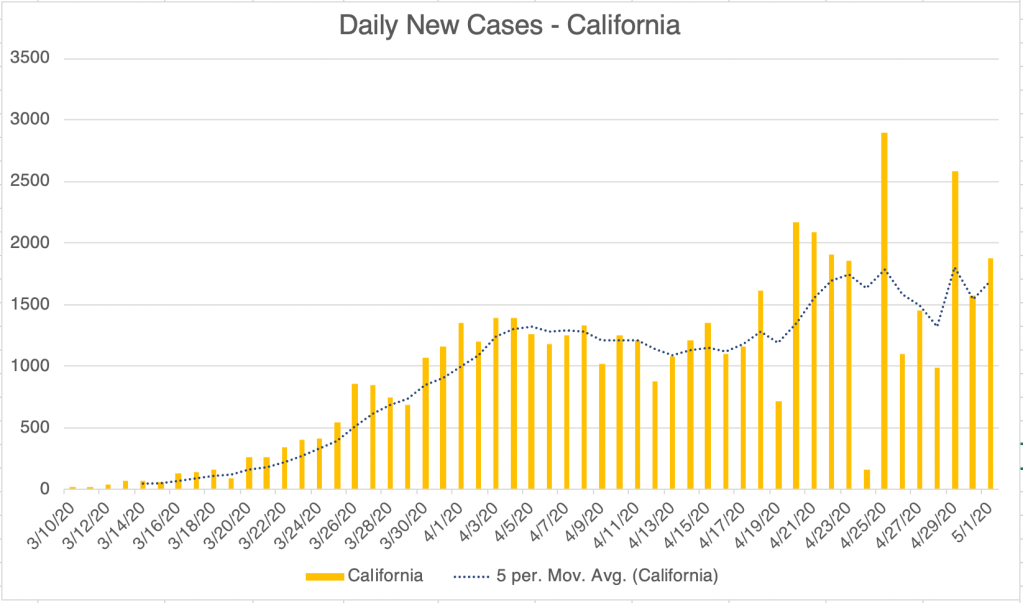
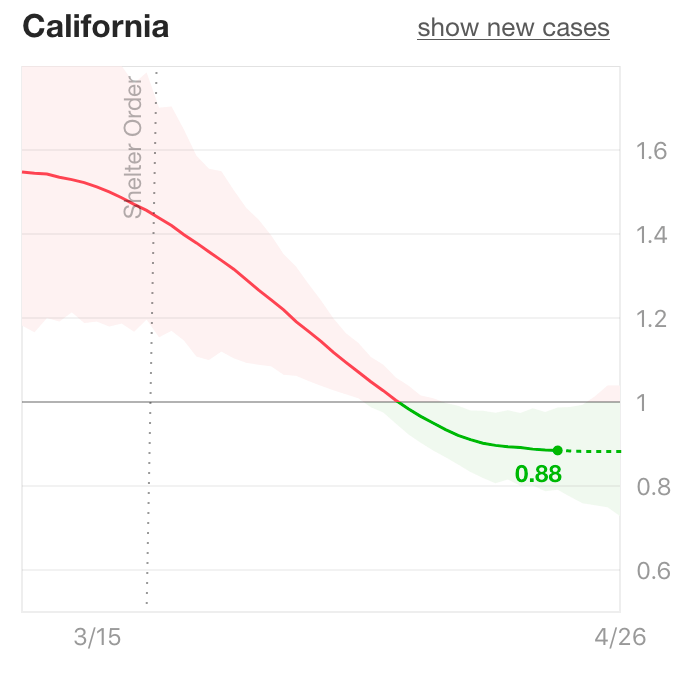
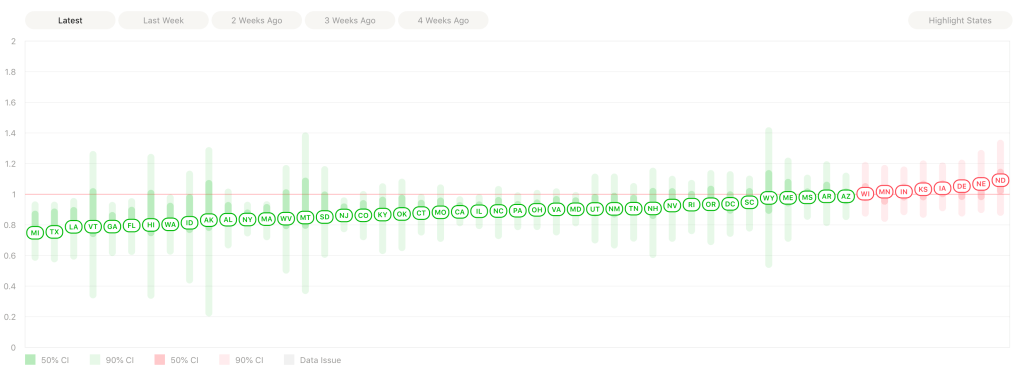
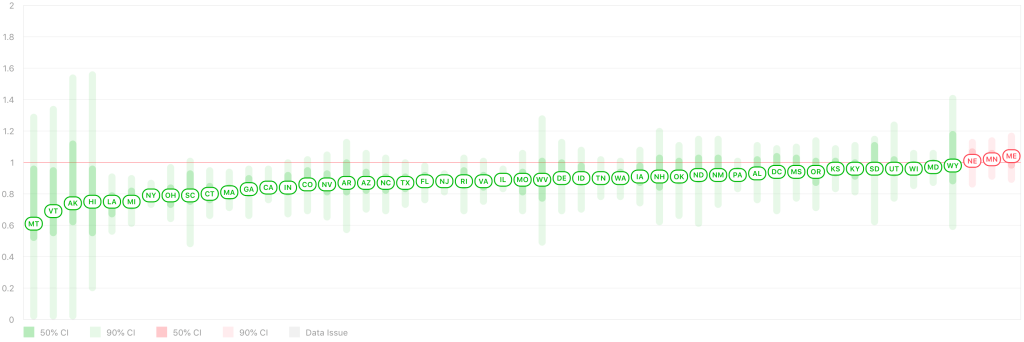
Re-opening: First, after many states have started to re-open, Rt Live is showing that all but 3 states have an Rt value below 1. This means that for most states, each infected person is passing the virus to less than 1 other person, and the virus is slowly disappearing in that state.  The states with an Rt above 1 are Minnesota, Maine, and Nebraska.  After a poor initial response, I’m happy to say that New York State is doing very well now, and daily new cases are low in New York. In California, my home state, the number of new cases is flat, approximately 1700 cases per day since the middle of April.
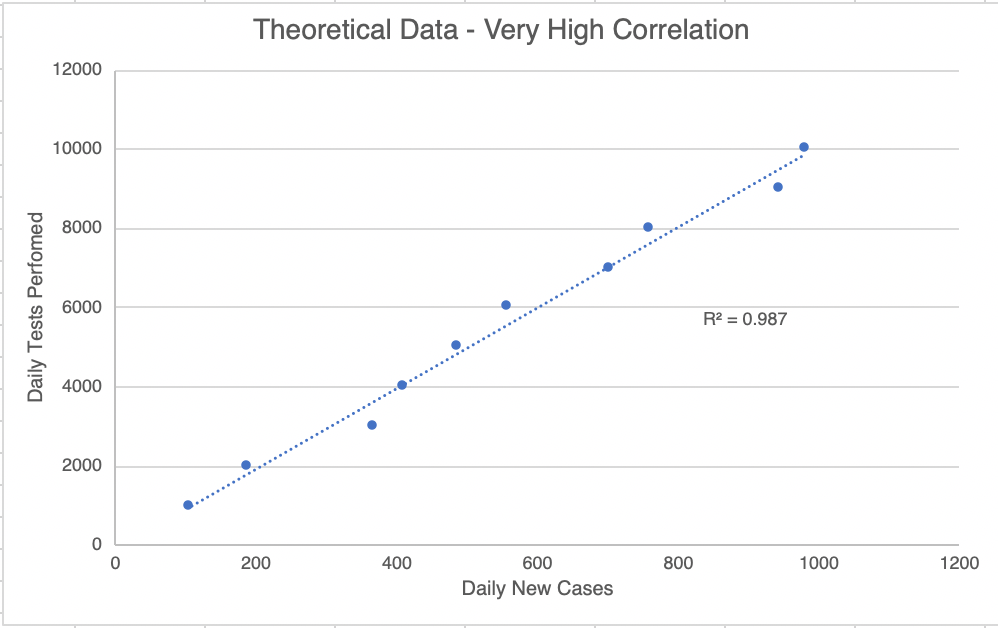
How many real new cases?  This is going to be a little mathy!  I told you I was going to start tracking the number of tests, and I have been doing that since April 27th.  This will help us know how many of the new cases are just because of more testing, and how many are actual new cases.  I’ve plotted the new cases against the new tests.  For each day, a point comparing the new cases and new tests is shown. If new testing matters, then a day with a high number of tests will also have a high number of new cases. To find out if this pairing exists, we can do a statistical test called the R2 test (pronounced “R squared”, also called the correlation coefficient).  This test creates a best fit line with the data and that creates an R2 value.  This value is a measure of how well the 2 parameters (new tests and new cases) are correlated.  I show a hypothetical graph in which the 2 sets of data are well correlated.  A perfect correlation will have a score of 1.0, while a set of data with no correlation at all will get a score of 0.0.  For scientists (at least the ones in diagnostics, like me) a correlation is considered “true” if the R2 value is above 0.95.  You could also say that the correlation is 95% likely to be true.
Now on to our data. I started plotting on April 27th.  5 days later, the graph for the United States got an R2 value of 0.6559.  This suggests that new cases and new tests are 66% likely to be correlated for this time period.  In real world terms, this probably means that some new cases are because of new testing, but some aren’t.

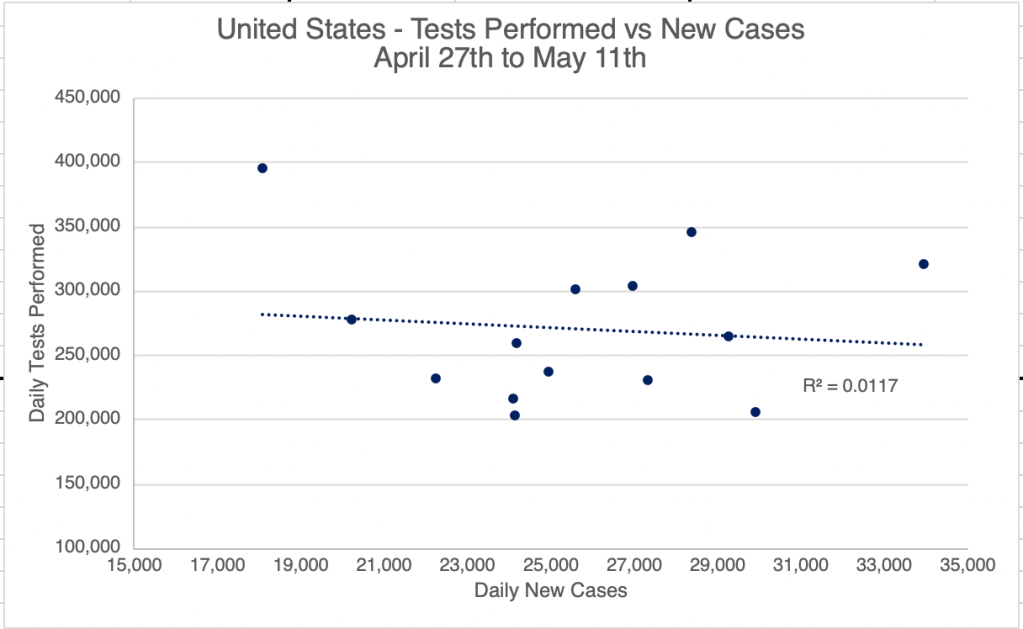
Interestingly, as of yesterday, a graph like this for the US gets an R2 value of just 0.0117.  This is very low and suggests that there is now no correlation between new testing, and new cases.  This means that new cases we see now are probably “real” new cases, and not just pre-existing ones that are just being found because of new testing.  For California, the correlation between new cases and new testing was never very high.  Right now, the R2 value is only 0.0039 for California, suggesting that most new cases discovered are “real” new cases.  What this means going forward is that we probably have enough testing now to locate new cases.  As we go forward, I expect we will start to see a steeper decline is new cases.

Good news!  This good news comes with a warning, however!  Those living in the West will easily understand a comparison to a brush fire.  Right now, we are in the “containment” stage.  We have the fire surrounded, and were at the beginning of the end, but if we walk away now, the fire will start to spread again.  We need to stay on task and keep fighting the fire!  I am all for re-opening, but we need to remain diligent.  Wear a mask when you go out into public, and continue to keep your distance from others!  If your workplace re-opens, you will probably want to wear a mask, wash your hands frequently, and sterilize your workspace often. I am probably going to start traveling for work again soon, and I’m very glad that everyone will be wearing a mask on the plane!

Endcorona.org compares responses: I discovered a new website the other day, endcorona.org, from the New England Complex Systems Institute.  The group compares the responses and results from different countries.  First, “green” countries responded very well, and were able to get the virus under control quickly.  Aside from the good response, I also notice that most of these countries have relatively small populations.  You may notice that China also appears on this list.  Most experts agree that the data coming from China is not reliable, and they probably have many more cases than they are reporting. After intermediate cases in yellow are countries in red that need more action.  This includes the US.  If you’ve been reading my posts, you’ll recognize the “flat” curve of the US.  Yes, we’ve flattened the curve, but we haven’t been able to knock down our case load yet.  Other countries with similar flat curves include Canada, Finland, Indonesia, Panama, Poland, Sweden, and the UK. Other countries had low cases at first, but are now experiencing explosive growth in new cases, including Brazil, Mexico, and Russia.

After analyzing the responses of these countries, endcorona.org recommendations include the following, many of which you’ll recognize:

  1. Lots of testing to identify new cases.
  2. Isolating infected individuals, even from family members!
  3. Strict lockdowns.  The stricter the lockdown, the shorter it will be.
  4. Travel restrictions, even within the same country.
  5. Adequate health care capacity.
  6. Safe practices for essential services.
  7. Masks in public for everyone.

Viral spread: Erin Bromage, an Associate Professor of Biology at U Mass Dartmouth, has a very nice article on his blog describing how the virus spreads. It is well written for non-scientists and has lots of links to original research.  The take home lesson is that the virus spreads particularly well in-doors.  In addition, cough, sneezing, and to a lesser degree shouting, singing, and even talking are all risk factors in spreading virus.

That’s all for now!

Don’t fear, but be smart!

Erik
COVID Vaccine, Herd Immunity, and California Re-Opening

Today I’m going to wade into the piranha filled waters of the vaccine discussion. I’m also going to talk about the issue of herd immunity, and my advice for re-opening.  I’m not prepared for a discussion of the MRM vaccine that has been raging for the last several years, I’m going to discuss vaccines in general, and the hopes for a COVID vaccine in particular. I will say to start out, that I’m a big fan of vaccination in general, but each vaccine is different, and I may not be in favor of a particular vaccine.

Vaccines: I’m not an immunologist and I haven’t made vaccines myself, I’m just sharing with you what I’ve learned from an informed perspective over the last few months.  When I first started sharing about COVID, I said something wrong, that it would take at least a few months to create a vaccine against COVID, which seemed like a long time to many.  This was based on the time it takes to develop a flu vaccine every year.  In the Spring and Summer, scientists find out that strains are likely to cause flu later that year, and they begin making a vaccine. This process takes several months. As it turns out, it’s only this fast for flu because there is a standard way to make a flu vaccine, they just need to know what strains will be likely to arise in the Winter. And sometimes they are wrong. 

Unfortunately, however, there isn’t just one way to make a vaccine.  There are many different ways, and it can be different for every virus or bacteria.  So for every new infectious disease, a vaccine must be developed from scratch, testing all these different methods.  The process can take from 2 to sometimes as long as 30 years!  Some scientists have said that Dr. Fauci’s prediction of a vaccine by next Summer is actually very optimistic! In my informed, but not expert opinion, we should not count on a vaccine for this current COVID-19 crisis.  However, the vaccine work being done will likely help with future outbreaks.  At least part of Dr. Fauci’s optimism is that a lot of red tape is being cut to speed the process, and that’s good, but less development time will also mean more risk for the final product.

Herd immunity: I have heard many people promoting the idea that herd immunity will help us get out of the crisis. Even some governments have been promoting this idea.  Herd immunity is a useful discussion for diseases for which there is a vaccine, but in my opinion, it is not something we should be striving for now with COVID.  We shouldn’t put a bunch of people in danger to keep fewer different people out of danger. Herd immunity requires a lot of people to be immune, and that number is different for every virus.  I’ve heard the numbers 50 – 70% for COVID thrown around.  That’s a majority of the population!  Why would we risk exposing the majority to the virus to save the minority? To be crass, it’s kind of like saying that once the pool is full of bodies, no one else will drown.

Reopening: More states continue to begin the reopening process. I actually strongly support this, as long as people continue to take care as they interact in public!  Even California has entered Phase 1 (CA calls it Stage 2) today, Friday May 8.  The stages CA will use, as well, as the announcement for the May 8th reopening were announced by Twitter by the Governor.  Not my favorite method of making an official announcement, but there it is.  Re-openings have a much higher chance of being successful if we continue to take care! Continue to wear masks in public, and continue to distance when appropriate (see my May 5th post).  I’m hopeful that we can advance quickly through the stages if people continue to take precautions.  Also, it will be important for us to continue to expand testing, and for businesses to take advantage of expanded testing by screening employees as appropriate.  Some municipalities are starting to have drive through testing, including parts of San Diego (you must still have an appointment to be tested).  Check with your health care provider or public health department to see if and how you can be tested.  Keep watching how other states are doing!  We can learn a lot by observing what methods are working, and what methods are not!  I predict that outbreaks will occur in places that become relaxed too soon.

2nd Wave:  Again, I’m not an epidemiologist, and the following is an informed guess, not an expert assessment.  In my informed opinion, we will have second wave in the Fall or Winter, and history suggests it may be more severe than the first wave.  But I’m still optimistic.  Why?  Because I think that with expanded testing, we will be able to test far more broadly this Fall than we could in March and April.  This will help us identify and quarantine infected people rapidly, and will help us control the spread much better than in the first wave. For the 2nd wave to go well, we will need to stay diligent!

Don’t fear, but be smart!

Erik

Masks: What’s the Deal?

The messaging on masks has been very confusing.  For several weeks, the CDC said the public doesn’t need masks, then finally, the surgeon general was demonstrating how to make a mask out of a T-shirt. I’m convinced that the CDC was so slow to recommend masks simply because they have been so hard to come by.  But the delay in recommending masks has caused a lot of confusion. 

______________________________________
Section added 2/22/21: Masks have produced a lot of controversy, but I am a big fan of mask wearing indoors. This does several things, it usually prevents infection if you’re wearing an N95 or KN95. However, studies suggest that even if you get infected, a masks will help you have a lower initial viral load on exposure, greatly reducing your symptoms! I personally always wear a mask indoors, and I rarely eat indoors right now.

Outdoors are a different story. Unless you are in a tightly clustered large group of people, you probably do not need to wear a mask outdoors! Some municipalities encourage or require mask wearing outside, but this is usually unnecessary. I am not saying you should ignore local requirements! I’m just saying that when you are going for a walk, a hike or a bike ride, a mask is not necessary.
_______________________________________

First, let’s talk about the words you’re hearing now!

Cloth Face Covering: A “cloth face covering” (I’ll say CFC for short here) is not technically a mask as the CDC defines it, and is not considering Personal Protective Equipment (PPE) from a medical perspective.  This a t-shirt, bandana, buff, or anything else that can be used to cover your nose and mouth.  The virus can still get both into your nose or mouth, or leave your body through these coverings, but it’s much better than nothing.  A lot of people who are trying to be responsible, but can’t find a mask to buy, are using these coverings.  If you hear someone saying they don’t work, they mean that they aren’t completely effective, but they are much better than nothing! Even if you sneeze, a face covering will capture larger droplets, slow the velocity of the sneeze, and help protect those around you.  If all you have is a CFC, you should still wear it when you go out!

According to Fischer et al, gator style masks may be even worse than wearing nothing at all, since they may break up droplets into a smaller size that stays in the atmosphere longer! So avoid a neck-gator style mask!

A surgical style face mask.

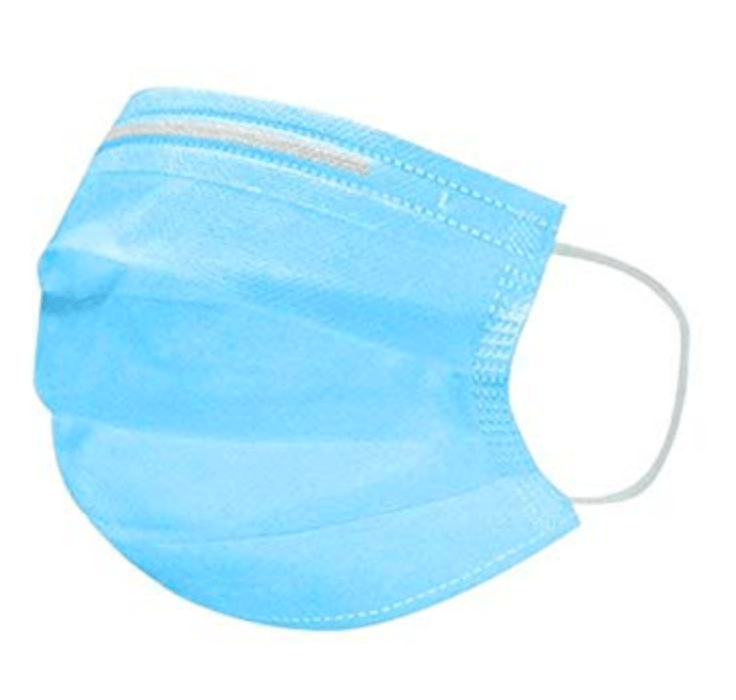
Face mask: A “face mask” is a filtering mask that covers the nose and mouth, but does not seal around the nose and mouth.  This includes the blue surgical mask that you see a lot of today.  These masks are designed to prevent material from medical worker’s  face and nose from getting to a patient during a procedure, while still allowing somewhat normal breathing.  They filter incoming air to some degree, but there are large gaps at the sides of the mask, so there are not very effective at preventing infection by SARS-2.  Coughing, sneezing and singing will still expel air from the sides while wearing these masks!  They aren’t completely effective, but they are certainly better than nothing, and will prevent transmission through simple talking. If you have one, please wear it!

UPDATE: Now that KN95 masks and some N95s are available (see below), I can no longer recommend wearing these masks.

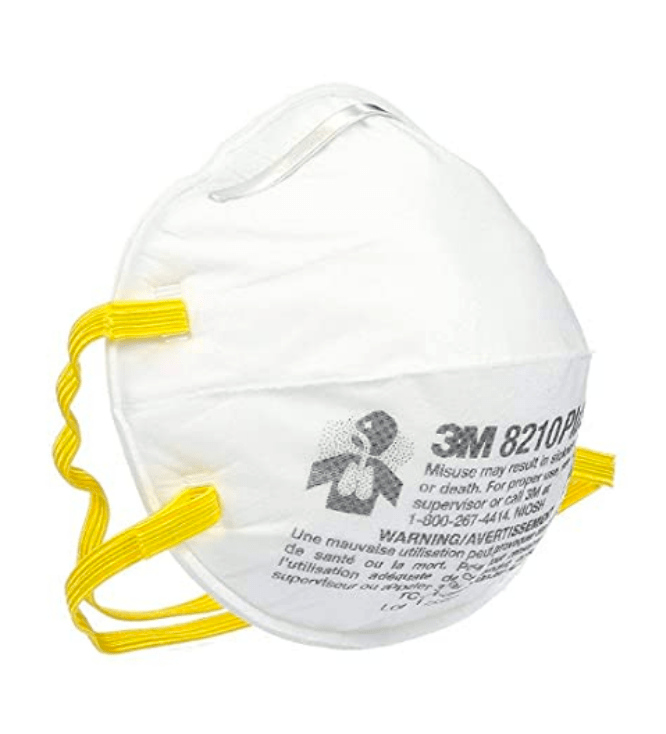
Respirator: These masks seal against the sides of the face cover at least the nose and mouth.  They are designed to filter the air and prevent particles from entering the nose and mouth.  N95s prevent 95% of viruses from getting through and are the preferred mask for medical workers in most situations right now.  Unfortunately, they have been in very short supply since the beginning of the pandemic, so the public is being asked not to purchase these for now.  Doctors tells me that N95s are not adequate protection while performing certain procedures on COVID patients!  One told me a story about 14 medical workers being infected by a single patient during a procedure!  This work requires a Powered Air-Purifying Respirator (PAPR).  These masks cover the entire face and also blow air into the mask, pushing virus out.

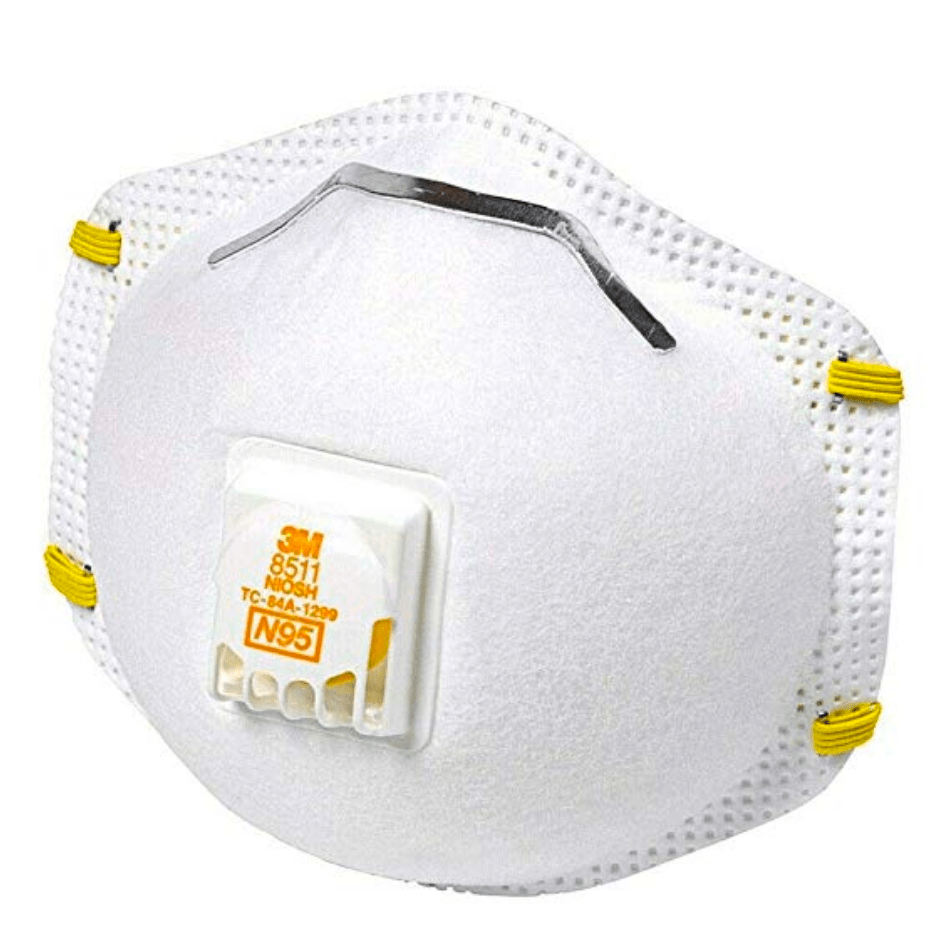
An N95 with a valve.

If you have an N95 with a valve in the front, these masks will still vent air when you cough or sneeze, so be aware that it will not protect others from virus coming from you! N95s with no valve are the best choice for protecting both you and those around you. Again, hold off on purchasing these until there are in greater abundance.

An N95 with no valve.

I see a lot of very nice looking fitted masks with a little round filter in the front.  These filter out large particles like dust or large droplets, but not necessarily small virus particles.  While much better than nothing, these are not necessarily N95 masks! Read the product information carefully when buying these masks.

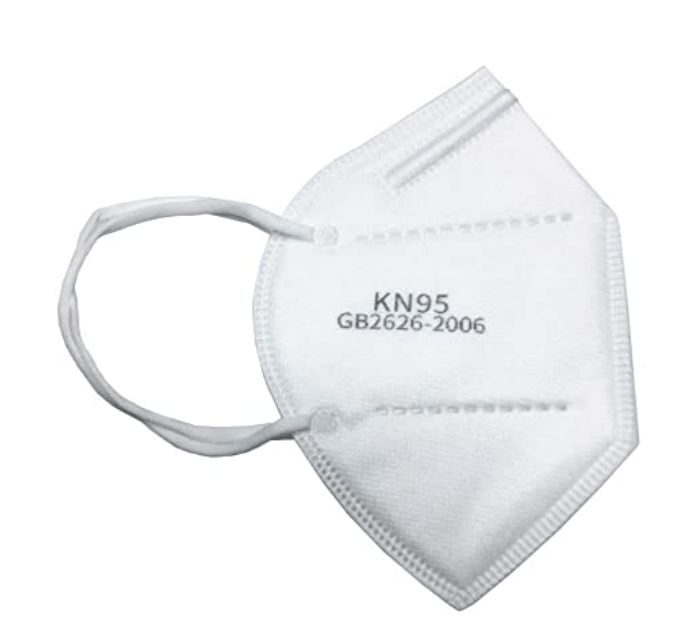
KN95 Masks: A new style of mask is being sold in the US now, labeled KN95. These masks are made in China and designed to filter out 95% of viral particles, like N95s. However, they are certified by a Chinese agency, and not by the FDA or CDC. They have been allowed to be sold in the US on an emergency basis. Users say they fit more loosely than N95 masks.

KN95 mask.

There are lots of studies showing the effectiveness of these masks, and unfortunately I don’t have one ultimate study to share with you.  Suay, a clothing company in LA, did a study suggesting that normal blue shop towels (like Tool Box Shop Towels or Zep Industrial Towels) do a much better job at filtering than cotton, and are a cheap and available alternative to an N95 when sewn into a mask. My sister-in-law Penny is part of a team that makes masks for the local hospitals in Bozeman.  These are homemade masks with a pocket for a HEPA filter. She’s sending me some, and I’m going to add a Shop Towel to mine! Both designs are posted below.

Here’s a few tips for wearing your mask:

  1. Your CFC or mask must cover your mouth and nose.  Leaving your nose hanging out, or simply wearing it as a chin mask is not adequate! 
  2. When adjusting your mask assume both your hands and the mask are contaminated.  Wash your hands before AND after adjusting.
  3. 30 min of UV light effectively kills SARS-2 virus.  In the bright sunlight, it may only take a few minutes.  I sterilize my mask by leaving it in the sun for a half hour after a shopping trip.  If you have a cloth face covering or mask, machine washing is a better choice.

In addition to preventing infection, masks appear to reduce the viral load in newly infected patients, leading to less severe symptoms! So even if you get infected while wearing a mask, your symptoms are likely to be less severe!

As we think about re-opening the economy, face coverings, even the bandana type, will really help keep new infections low.  So wear a mask when you go out in public! Any improvements will hasten the day when businesses can re-open. I am awaiting data to see what the infection rate is at businesses in which employees wear masks. Hopefully, this data will come out soon.

Don’t fear, but be smart!
Erik
___________________________
Update, February 23rd, 2023,

Cochrane Report on the Effectiveness of Masks:  Jefferson et al released a meta-study through Cochrane Reviews on the effectiveness of medical masks (surgical masks) and medical respirators (N95) in public settings.  A meta-study is a study in which the authors gather information from published articles and try to draw conclusions from a large body of data. They do not gather a new set of data.

The Jefferson et al study reviewed 78 different studies, including data from pre-COVID flu outbreaks.  Their conclusions are sobering.  First, the authors suggest that there is virtually no benefit to wearing a medical surgical mask over not wearing a mask in most settings.  If you’ve been reading my blog for long, you will know that this conclusion does not surprise me.  Blue surgical masks have large gaps in the sides and do not filter air leaving the mouth and nose.  They were designed to prevent droplets from a medical worker from contacting a patient, not to prevent transmission of aerosol based agents.  This is a problem, since most mask wearing people in public during the pandemic were wearing surgical masks.  These people thought they were protected from aerosols, but they were not.

The study also concludes, however, that N95 masks didn’t perform much better.  In fact, for lab tested COVID, the difference was statistically insignificant, meaning that the difference between wearing N95s or surgical masks was so small, it could not be proven to be a real difference statistically. 

I have to point out that the Jefferson meta-study points out that many of the studies they reviewed had various failings that may have made them unreliable.  Much of the data was collected through self-reporting of participants, which is a source of inaccuracy, and participants were often non-random, making application to the general population difficult.  So some of the conclusions may have suffered from these kinds of errors.

As you know, I’ve been a proponent of wearing N95, KN95, or KF94 masks when indoors during the pandemic.  Unfortunately, N95s are tight and intolerable for most people for long periods, so most people didn’t want to wear them at all.  Those that did were not careful to make sure the mask fits properly, making the mask ineffective.  This is part of the reason I wore a KF94 (Korean) during the later stages of the pandemic when I had choices.

So have I been wrong this whole time?  Well, yes and no.  I wore a KN95 in all kinds of environments while traveling during the pandemic.  When I finally got COVID in January of 2021, I was not wearing my mask, working in a “gray area” environment with people that I later found out had COVID.  I was technically indoors, but the room had a lot of ventilation, so I thought I would be OK. Obviously, I was incorrect.  All this to say, I think my KN95 was effective for much of the pandemic.  On the other hand, I am a scientist in the infectious disease field, and have had a lot of experience wearing and fitting these masks to myself, so I am not a typical user.  It may certainly be that my experience does not translate to non-scientists.

If you still have not had COVID and are not high risk, I might say that the current version has an extremely low fatality rate, and it may now be worth the risk to say good-bye to the mask.  I know the large majority of you have done this already.

If you are at high risk, I still think an N95, KN95, or KF94 can be effective for you.  In order for it to be effective, however, you need to make sure it is properly fitted, making sure you don’t have gaps between your nose and cheek.  The mask should filter the air coming into your nose and mouth.

Since I had COVID last January, I no longer wear a KN94, and enjoy eating indoors in restaurants again.  I’ve basically been back to normal for a long time.

Dr. Visay Prasad has an excellent video describing some of the details of the meta-study.  He is an epidemiologist from UCSF. 
____________________________________

CDC report on filtration.

Masks effective in protecting healthcare workers, Bartoszko et al.

Study on the best masks, Fisher et al.

Mask may reduce symptoms and even provide some immunity, Ghandi et al.

Case Update: May 2nd, Video: Simulating an Epidemic

The number of news cases has been erratic in the last week, but at least in the US, it continues to trend downward. I’ve started collecting the number of new cases in the US and California, and while I’m not sure how to integrate that data into my Excel spreadsheet yet, I can tell you that more tests definitely mean more new confirmed cases. So some of the erratic graphs were seen are definitely because of more testing. In the long run, I expect to see new cases come down drastically as we continue to increase testing.

Rt.live is showing that 45 of 50 states have an Rt value below 1 yesterday. This is great news, as it shows that in most states, the virus is slowly disappearing. I’m watching with great interest to see how the states that have started re-opening do. Keep up the great work! We are having an impact!

Also included is a very interesting video I ran across, Simulating an Epidemic, showing a non-scientific computer model of possible epidemic outcomes given different approaches. Keep in mind, this model is NOT attempting to show what will happen in the COVID epidemic, just some theoretical things that might happen given different approaches. He does NOT attempt to prove that any of these things are what’s happening.

The most interesting parts for me were when he compared 2 methods that have been used in different places. At 6:00 minutes, he talks about the Detect and Isolate method, which I favor. This is were you find an infected person and quickly quarantine them until they have recovered. He argues that this is the most effective method in an epidemic like the current one. We haven’t been able to do this, really, because of our lack of testing in the beginning. My fervent hope is that if we get a second wave in the Fall or Winter, we will be ready for this approach.

At 16:50, he talks about a method that I think we are kind of using, the shelter in place, but with trips to central locations. He says that without other measures, these locations become a source of new infections. This is probably not happening as badly in real life because so many are wearing masks to the store!

Don’t fear, but be smart!

Erik

San Diego County News

Friends,
For those of you living in San Diego County, there is a lot of news on the evolving situation in San Diego and California.

First, San Diego County reports that the county has met 4 of the 5 criteria for entering Phase 1 of re-opening. We have had down-trending new symptoms and cases for the last 14 days. However, to meet the last criterion, the County needs to have more testing, PPE, and hospital capacity available in the county. Let’s hope this happens soon!

Also, after a brief beach opening for walking, swimming, and surfing, Gavin Newsome has closed all beaches and state parks effective today, May 1st.

Also on May 1st, face coverings will be required in San Diego County.

Please see the SD County news page for ongoing updates.

Don’t fear, but be smart!
Erik

San Diego County Will Scale Up Testing and Contact Tracing

Originally posted on April 29th, 2020 on Facebook

Brit Colanter just shared some info from San Diego County Public Health. San Diego will be scaling up contact tracing soon! This is the practice of informing those who have been in contact with sick individuals. This technique has been very helpful in some of the more successful countries, So. Korea, Taiwan, and others. It will help us get back to normal more quickly!

Quest Releases Antibody Test That you Can Order Online

Originally posted April 28th, 2020 on Facebook

Friends,
Karen Parrott just informed me that Quest Diagnostics has released an antibody test for SARS-2 that you can order online without visiting your doctor. You will still need to visit a lab and have your blood drawn and the test will be performed at a Quest facility. It remains to be seen if the general public will be offered the test right away, or if only essential workers will get the test initially. If you order the test, please let me know about your experience!

The test only detects IgG antibodies, and not IgM (see my April 22nd post). Thus, it can tell you if you were exposed to the virus more than 7 days ago, but not necessarily if you are currently infected. The test has not yet received Emergency Use Authorization (EUA) status, but Quest claims it is based on well known technology and will receive EUA status soon. No information on the likelihood of false negatives or false positives have yet been published. A false negative result is more likely than a false positive result for this kind of test.

If you take this test, make sure you read all the material they give you on interpretation! The list cost of the test is $119.

Full disclosure, I worked at Quest for 15 years, but I don’t work for them now, and have no financial connection to them.

Thanks,
Erik

Quest Diagnostics Launches Consumer-Initiated COVID-19 Antibody Test Through QuestDirect™

Science Communication, and Being Persuasive

Originally posted on April 27th, 2020 on Facebook

Friends,
This post doesn’t have much science in it, it’s about why I started posting about the virus, and something about my philosophy on communication. If you’re not interested in that, feel free to skip it.

Much of the reason stems from how scientific information is often communicated to the public. So often a scientist or public official shows up on a news show, and basically gives a conclusion, but no real data. Instead of giving a persuasive case, they just make a claim without much support. Because of this, many in the public have been confused or lost trust in what they learn from the media.

On March 9th, I started posting to Facebook, since I don’t yet have a blog. If you’ve been one of my Facebook friends for a long time, you know that I rarely post, really only to change my profile picture for Talk Like a Pirate Day! I felt it was important to give some data in a digestible way, so people would have some understanding of what was going on. I just wanted to show some data so people could understand why SARS-2 was not like the typical flu.

I started out by giving my credentials, since many of you, especially my high school friends, may not have even known I was a scientist. And yes, it might have helped me get my foot in the door with some of you. However, one of the things I don’t like about our public discourse, is how many scientists expect that their credentials means that they must be believed by the public. Being an expert isn’t enough to automatically be believed. You still have to show your data and show why it supports your conclusion. Anyone who has been to a scientific conference or even a journal club knows that experts often disagree. You can’t just say “I have a PhD” to a room full of PhDs. So when experts try to make a case to the public, they still need to show data, and how they came to their conclusion. Unfortunately, because they often just have 60 seconds on a news show, they don’t have time for that. What too often happens, is that they just make a claim without support, and say that if you don’t believe them, you’re just a <news anchor, YouTuber, insurance salesman> or you’re just anti-science or racist or whatever. This is just lazy, and ironically, is anti-science. Scientists must make observations, show data, and be persuasive. Taking short cuts like name-calling isn’t persuasive, and it just makes your opponent irritated and unwilling to listen. In fact, if your opponent knows how to argue, you’ve just clearly told them that you can’t make your case. You lose.

Here’s what I do: I show a piece of data, then say what it means. I’m prepared to tell you where the data come from, and how I manipulated it if I did. If I quote a source, I give a reference. This shows I have reliable information, and also relieves me of some of the burden, since I’m just reporting what someone else said. I also think graphs are much easier to digest than tables, and tables are much easier than numbers in a paragraph, so I make content visual when I can.

If a news story makes a scientific claim, I try to find the original source, since journalists often oversimplify, misunderstand, or misrepresent scientific information. Politics and science make a terrible combination. As soon as a scientific issue gets politicized, it becomes difficult for scientists to figure out the truth, and nearly impossible for the public to. If you want to understand a scientific issue that has become political, you’ll have to read widely on all sides of the argument. Most people just don’t have time for that.

Here are a few of my rules for being persuasive. If you’re one of my lunch buddies from Quest, you know I did this well sometimes, and also failed sometimes!

  1. If you can’t support a claim, don’t talk until you can. Go study and come back.
  2. If you do speak, don’t just lean on your credentials or criticize someone else for not having any. You both need to be persuasive. And if you have data and can support your claim, you don’t need a degree, although training certainly helps to develop these skills. I am a molecular biologist, specializing in medical testing. I am not an epidemiologist or a physician*.
  3. If someone asks you to support your claim, and you find that you can’t, you may need to change your position!
  4. Ask clarifying questions. This may give you time to think, and also helps you learn their position. It’s OK to have an entire discussion in which you only learn their position.
  5. Don’t accept the burden of proof. When someone makes a claim, many will just offer an opposing claim. When you do that, you’re accepting the burden of proof! Don’t do that! Just ask them where they heard it, or why they believe it. A lot of people can’t tell you either of these things.
  6. If you don’t know something, say you don’t know. Making something up undermines your credibility! You may lose a discussion in the short term, but you’ll build trust.
  7. Don’t hide important information. This of course is a favorite trick of media and politicians. It’s a handy way to deceive your audience without technically lying. However, if you’re caught doing this, you completely undermine your credibility. Plus, you can’t really hide the opposing facts, you just bury them alive. They’ll eventually come out like a zombie and eat your brain.
  8. Your job is not to “win”, it’s to be persuasive. Jerks aren’t persuasive. Play the long game! It’s OK to lose a discussion if you can earn another discussion by being respectful.
  9. Find common ground and build from there. If you can show your opponent that you’re on the same team, you have a head start.
  10. If you find that someone is more interested in being insulting than seeking truth, it’s OK to disengage. Some also give you a burden of proof so great, it’s impossible to meet it. They may not be seeking the truth, and there are some people that you will never convince. Relax! It’s not your job to convince everyone!
  11. Don’t post angry! Take a walk, have lunch, maybe even sleep on it, and think before you respond to something obnoxious. You will lose credibility if you say something destructive. While live conversations are always better, social media allows you to think before you post!

Don’t fear, but be smart!
Erik
*A medical license grants the legal right to order tests, interpret results, prescribe medication, and give medical advice. Also, your doctor knows your medical history, and the particular tests and medication you’ve taken. So always consult with your doctor when making medical decisions!

____________________________________
Update: October 26th, 2021
This past few years have become incredibly contentious and polarized in the US on many important topics of public life. So many times, the default response to disagreement has become to break off discussion and even relationships. This is a tragedy. In addition to above points, I’m adding a new one:

12. When discussing a controversial topic with someone with whom you disagree, do your best to at least understand why your opponent would hold the opinion they do, rather than just assuming they are crazy or evil. This has 2 functions, it allows you to consider points that you may have not considered before, and it also allows you to better understand their view so you can know how to address it. You may still disagree, but you’ll be better equipped to address their view, and may also be able to preserve the relationship.

Case Update: April 27th

Originally posted on April 27th, 2020 on Facebook

Friends,
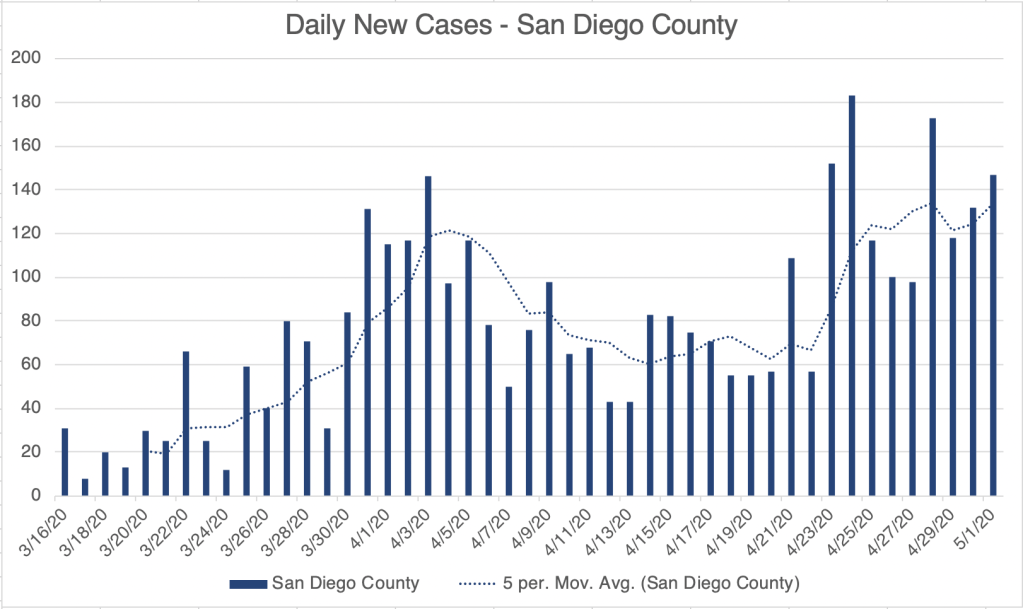
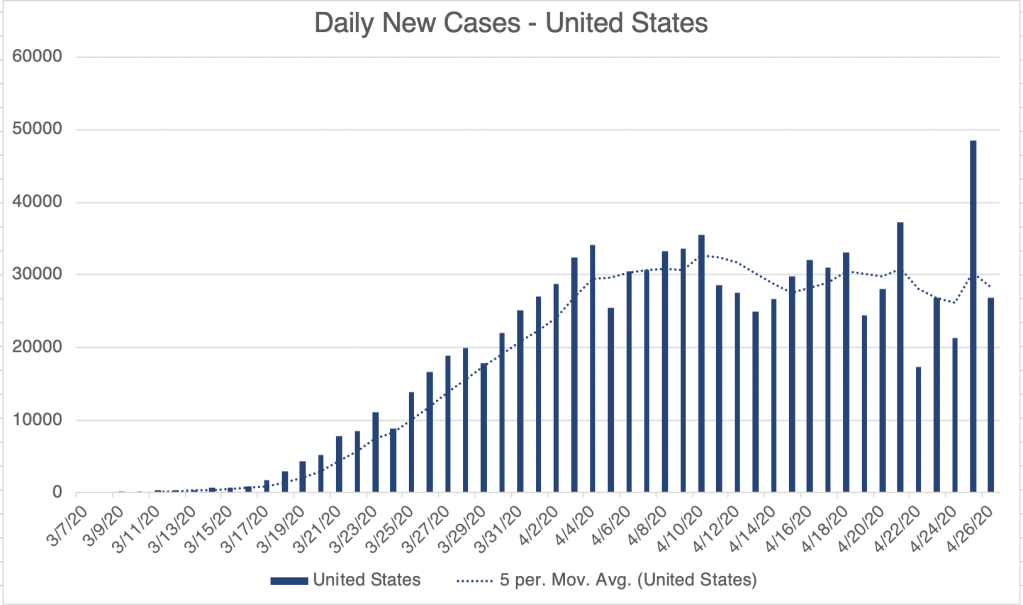
On April 22nd, I showed you data with a big increase in cases from the previous few days. Several outlets have confirmed that increased testing is leading to this apparent big increase in cases. The Johns Hopkins site that I get my data from has started releasing testing numbers as well, but I haven’t been collecting those. I’m going to start, but it will be awhile until I can meaningfully integrate that information. Labs often release reports in big batches, so this makes the graphs like mine look erratic. For the US, California, and San Diego County, there is an apparent increase in cases for the last week or so. Much of this is because of increased testing. As testing catches up to real cases, we’ll know better what our real case load is.

Some good news is that the site I introduced on April 20th, rt.live, has made some revisions to their model. They claim they’ve corrected for the increase in testing, and now most states are seeing a nice downward trend, and all but 7 have an Rt value below 1. This means that each infected person is passing the virus on to less that 1 other person, so the virus is slowly going away in that state! That is great news! This will also impact what states can move into the 1st reopening phase.

A doctor friend of mine says that the number of deaths per day is perhaps the most reliable way to tell for certain that the virus is receding, because this number is not confounded by the number of tests being given. This is certainly true. Unfortunately, deaths sometimes occur weeks after infection, so it takes a long time to see the impact of a change in behavior if we wait for the number of deaths to inform us. So no number is perfect. Also, there has been controversy about how deaths are reported. Some cases of COVID have been confused for flu or other pneumonia and vice versa. Only the reporting physician may know all the factors going into that decision, so we often can’t figure this out by looking at the numbers.

Our efforts are having big impact, and several states will start reopening today! We can certainly hope they will be successful.

Don’t fear, but be smart!
Erik

Rt Live

Dr. Erickson’s Video and the Fatality Rate

Originally posted on April 25th, 2020 on Facebook

Friends,
This one is going to be a little mathy. Several people have sent me the video titled “Dr. Erickson COVID-19 Briefing”. I’ve watched the first 12 minutes of the 52 minute video. Dr. Erickson argues that we have a large number of current cases, and that when comparing this number to deaths, he calculates the fatality rate at between 0.03 and 0.07%. This is less than the typical flu. He uses data from his home county of Kern County in California, NYC, the US, Spain, and others. Unfortunately, Dr. Erickson makes a critical error in his calculations.

For the US, he says we have 802,000 confirmed cases (around April 20th) and around 4 million tests. This would give him a positivity rate of 20% for the country. He then calculates that we then have 64 million cases in the country and only 45,000 deaths, giving us a fatality rate of 0.07%

The mistake he makes is that he assumes that tests given represents a random sampling of the population. Anyone who has tried to get a test and failed knows that not everyone who wants a test gets one. And not everyone requests a test either. Dr. Erickson has what’s called a sampling bias. You have to make sure you have a sample that represents the group you want test if you want to say anything about that group. Instead of testing the general population, Dr. Erickson is testing just people who meet the criteria for testing by the CDC or other health care body. This group is far smaller, and far more likely to have the virus than the general population. He over-estimates the number of COVID cases, by maybe 10 fold.

Several studies, some not yet published, have tested random selections of the population using PCR and antibody tests (see references 1, 2, 3, below). In those studies, fatality rates range from 0.12 – 0.7%, 2 – 23x higher than Dr. Erickson’s estimate. Also, the studies by Bendavid and Sood (2, 3) suggested that approx. 4% of the populations of Santa Clara County (San Jose) and Los Angeles were infected in early to mid April. So 96% of the population is still susceptible. At the 0.12 – 0.7 death rate, that’s 6,000 – 37,000 potential deaths for those 2 places alone. Even these studies, with fatality rates far higher than Dr. Erickson’s, have been criticized for an estimate that is too low because of sample bias (4).

We won’t really know how many people have had it until there is wide spread testing. South Korea has done extensive testing, and their fatality rate is 2.24%. This might be in the ballpark of the rate in the US.

So I have to reiterate, SARS-2 is not the average flu. In addition to being up to at least 5x more deadly, it’s also 4x more infectious. The very good news is, our efforts are paying off, and the daily rate of new cases for the US is now just 2.46%, down from a terrifying 46% on March 19th. It’s right for some living in rural areas to wonder if they can begin the process of going back to normal. Some can, but it needs to be done carefully and watchfully, with lots of testing for exposure, not just for symptoms (See my April 9th and April 22nd posts). The entire state of Minnesota plans to do just that. We can watch in real time to see how it goes for them. We don’t want another Albany, Georgia! Urban areas like coastal California and the Acela Corridor will have to wait awhile longer.

Don’t fear, but be smart!
Erik

1. Sutton et al., Universal Screening for SARS-CoV-2 in Women Admitted for Delivery. April 13, 2020. NEJM, nejm.org
2. Bendavid et al., COVID-19 Antibody Seroprevalence in Santa Clara County, California, April 11, 2020, preprint by medRxiv
3. CBS report on upcoming study
4. Experts demolish studies suggesting COVID-19 is no worse than flu

PS. If you want me to watch something later in Dr. Erickson’s video, please tell me what the time reference is. I really don’t want to watch the whole thing!