Category Archives: Case Update

Case Update: July 7th, 2020; Antibody Dependent Enhancement

Dear Friends,
This is a case update. I’ll also have an important message about antibody dependent enhancement.

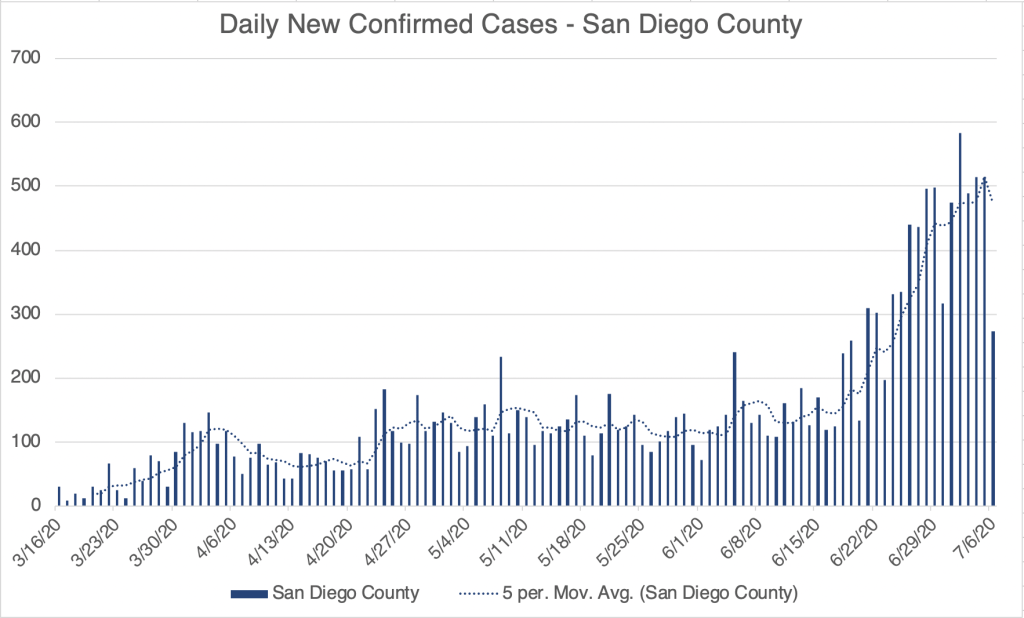
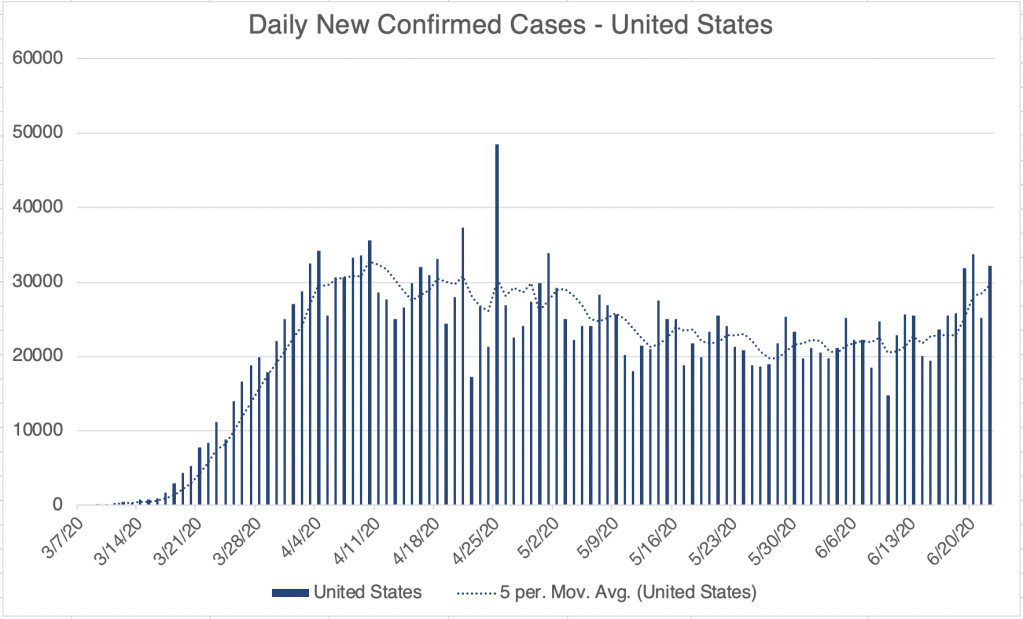
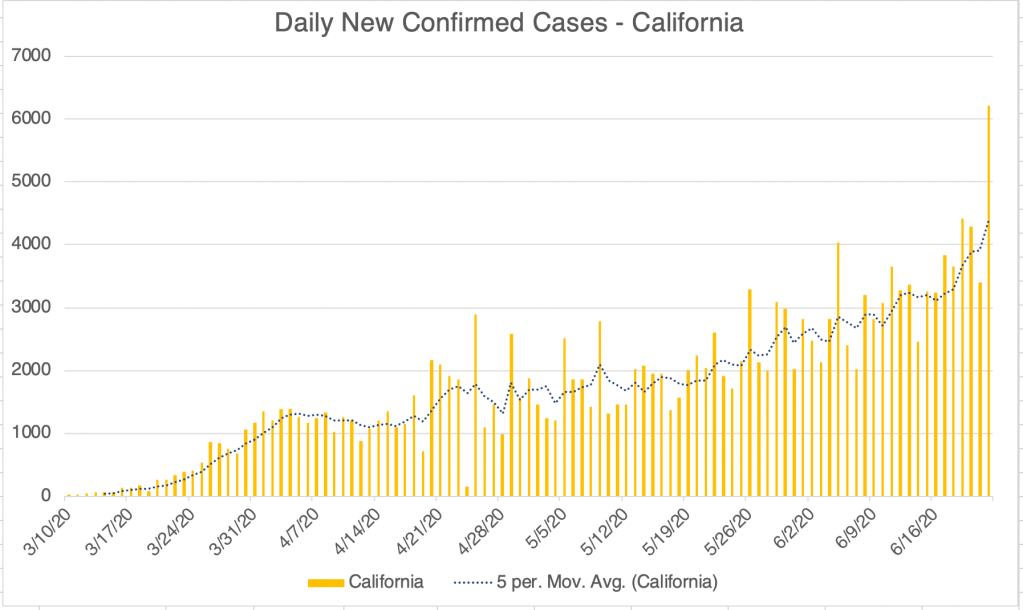
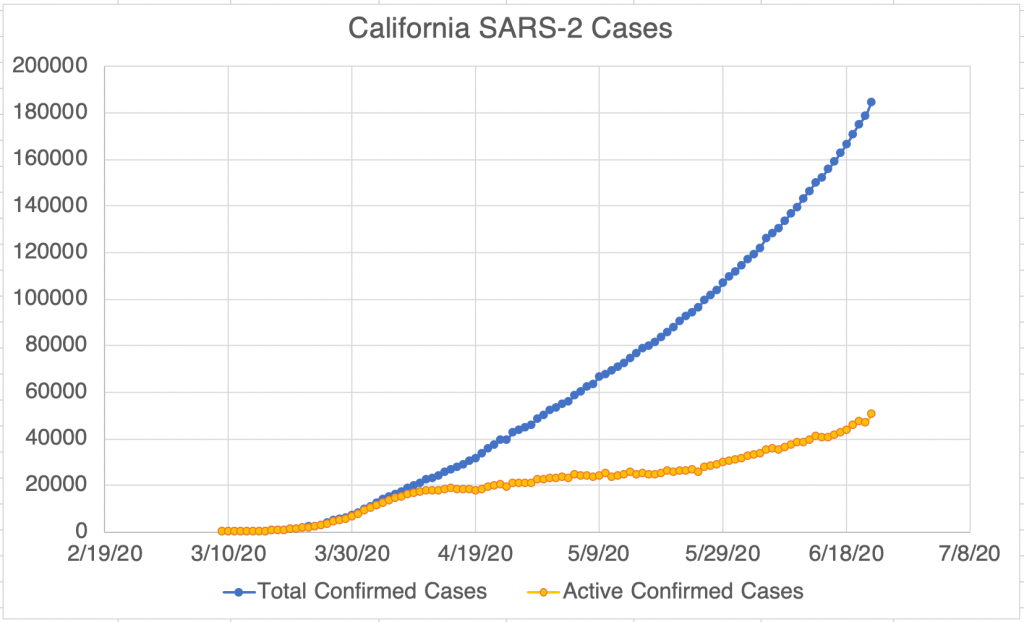
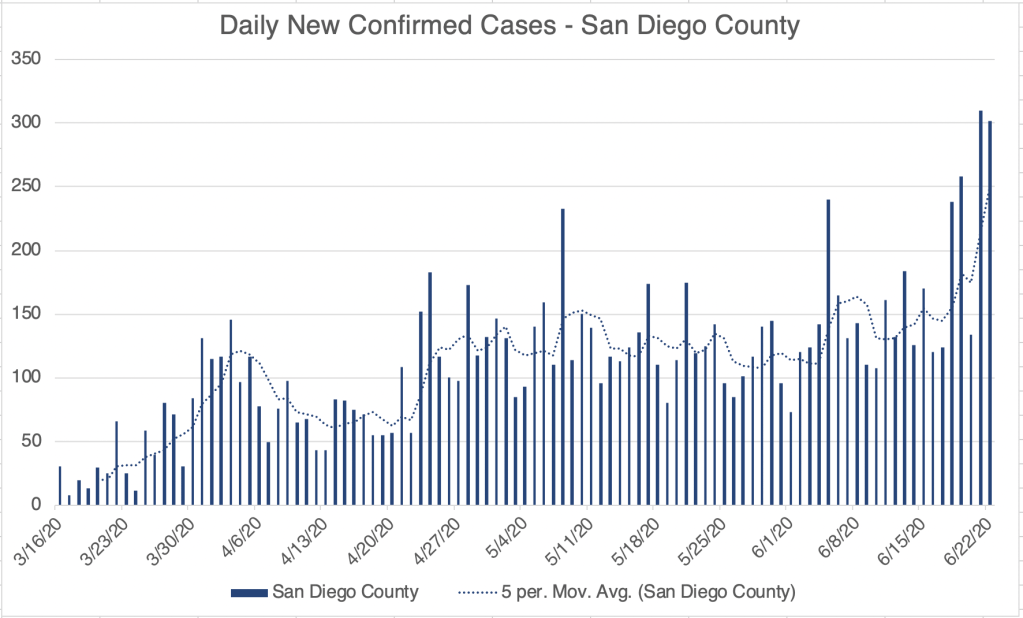
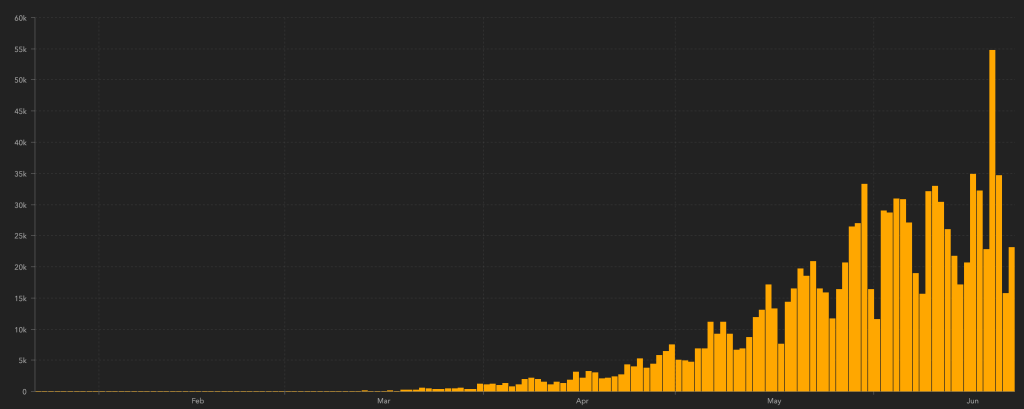
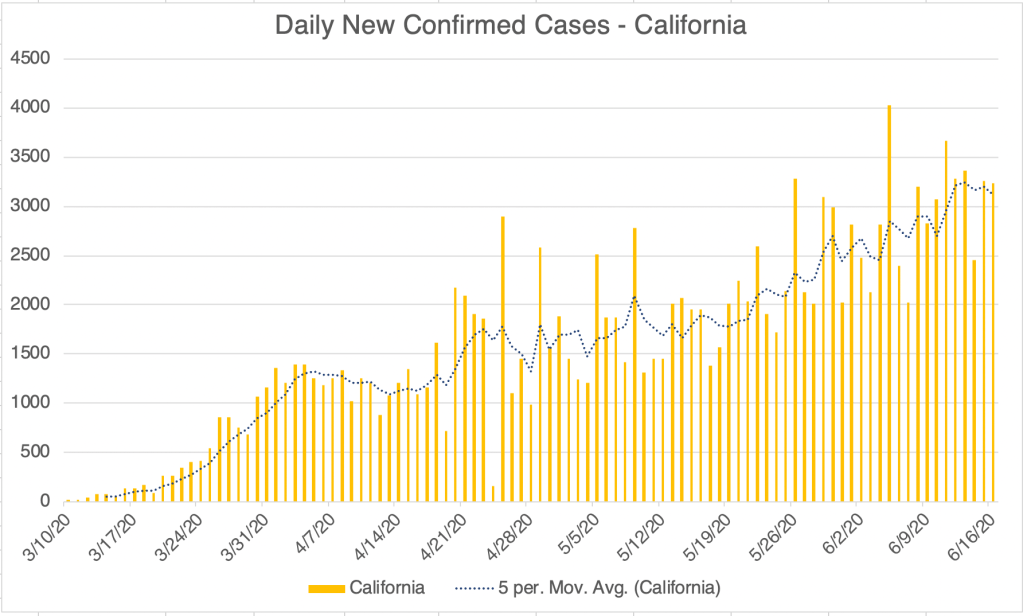
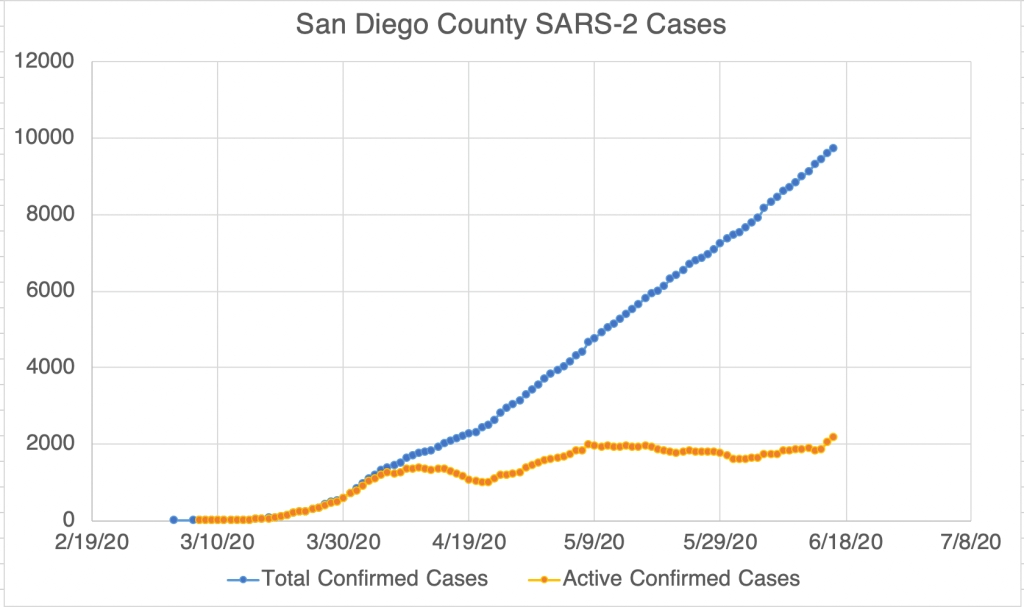
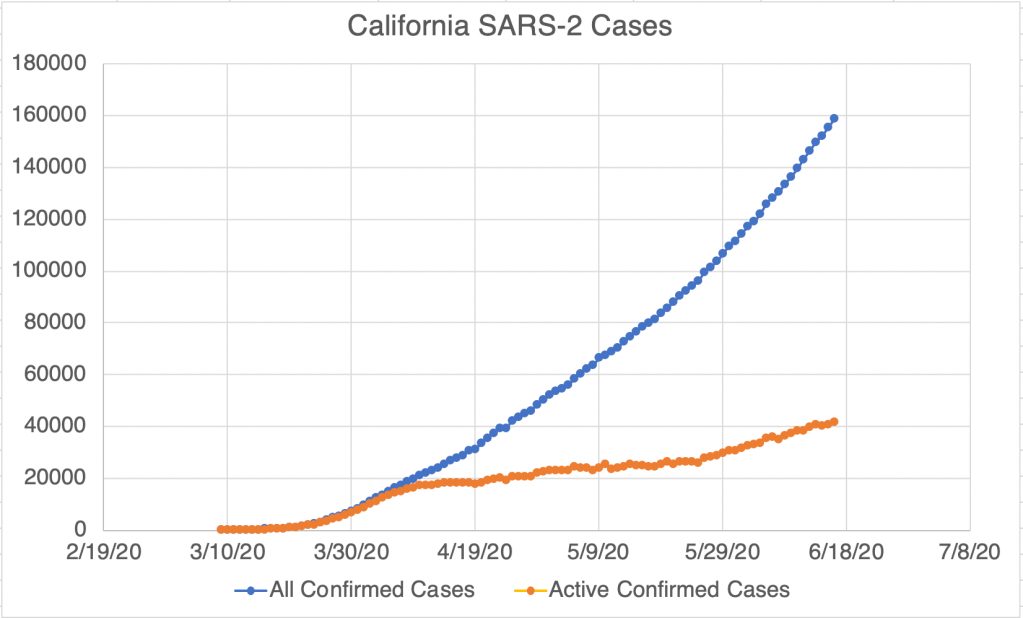
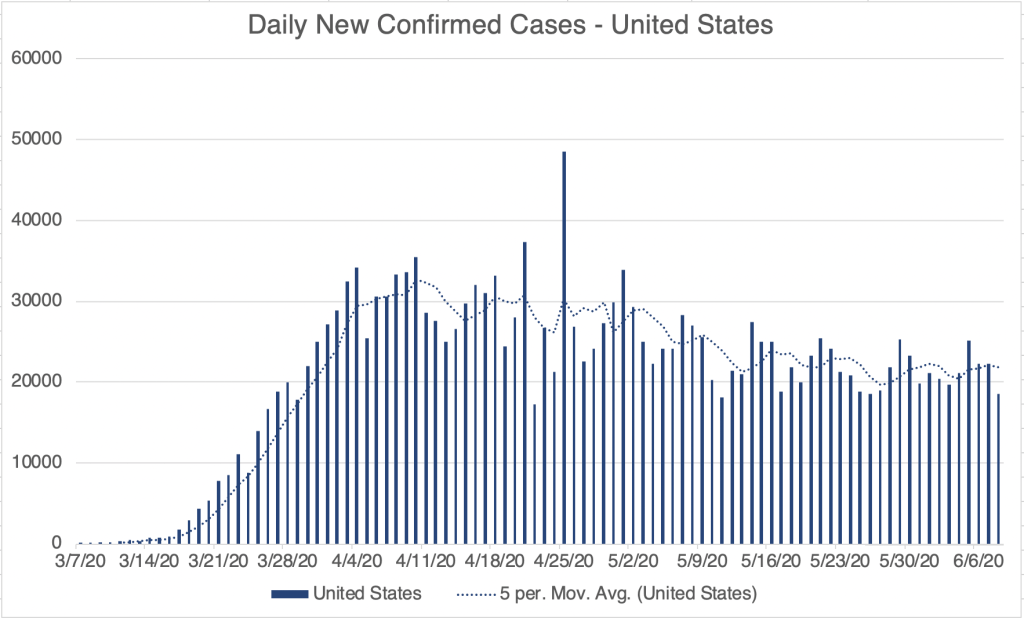
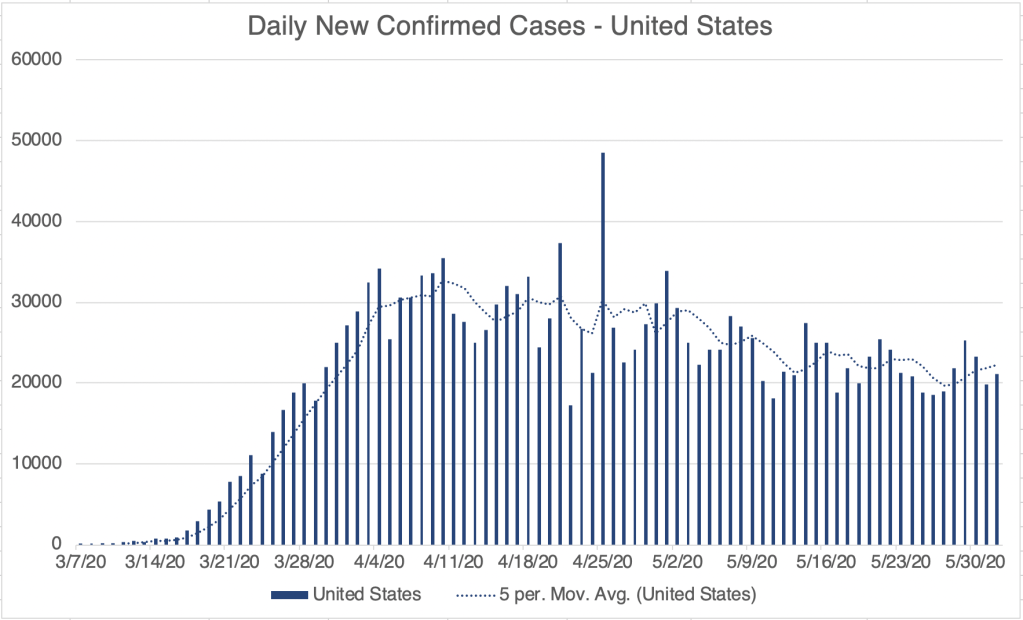
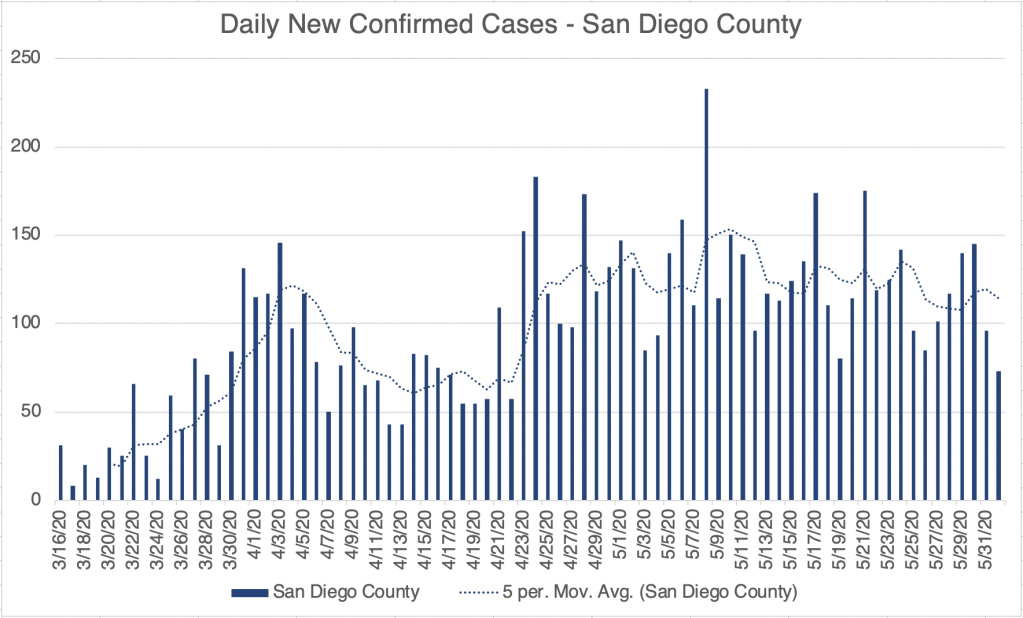
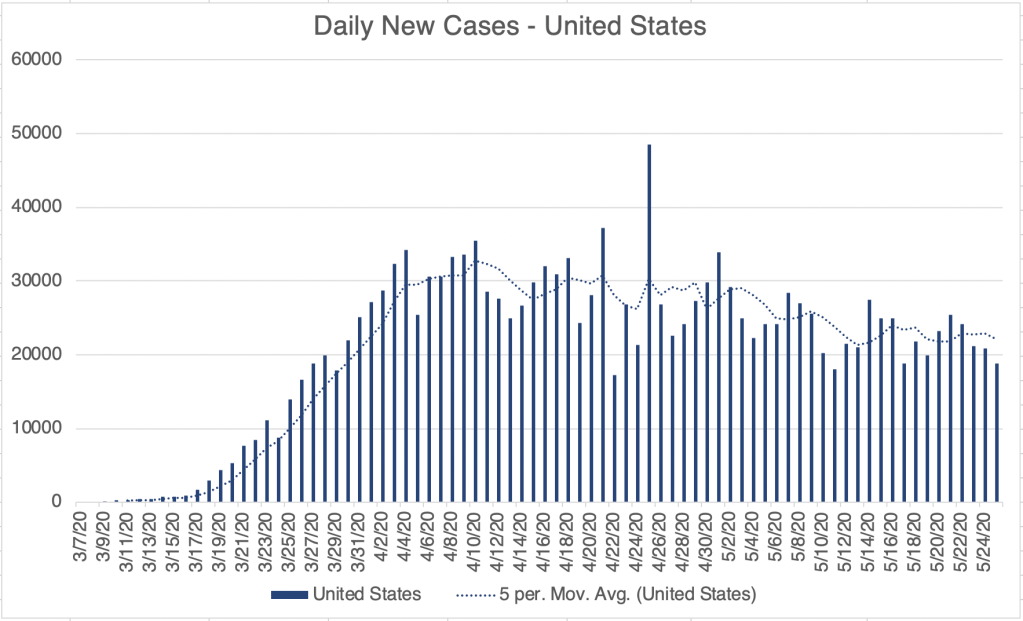
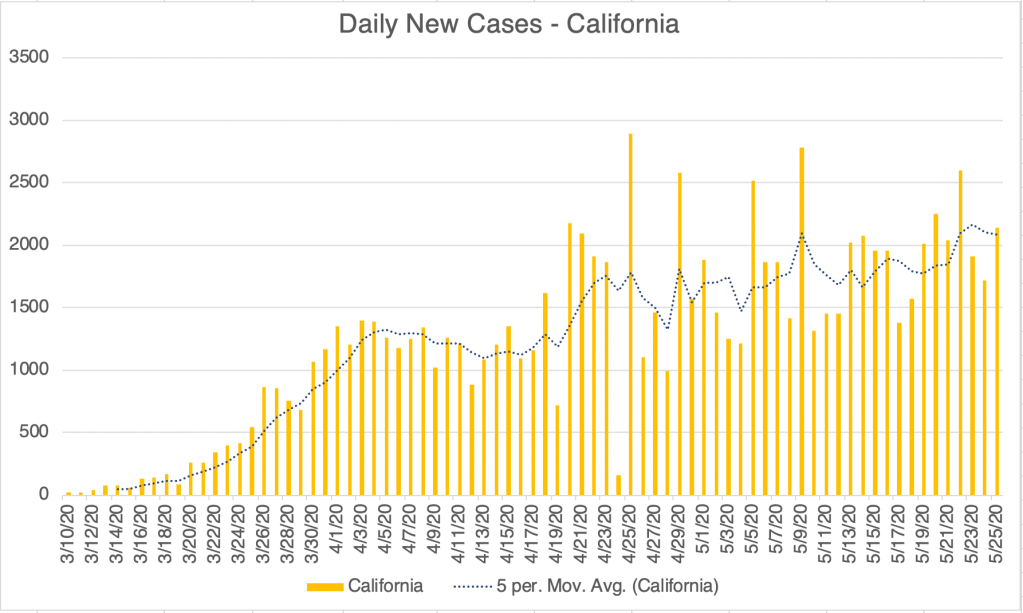
Cases continued to rise unchecked in the US, California and San Diego County in the last week, although the long holiday weekend did have impacts on reporting. Some good news is that the number of deaths reported in the US has been slowly declining despite the case increase. Keep in mind however, that deaths will lag behind cases by as much as 2 weeks, so we may yet see an impact from the higher caseload. The number of deaths have been trending flat in California.

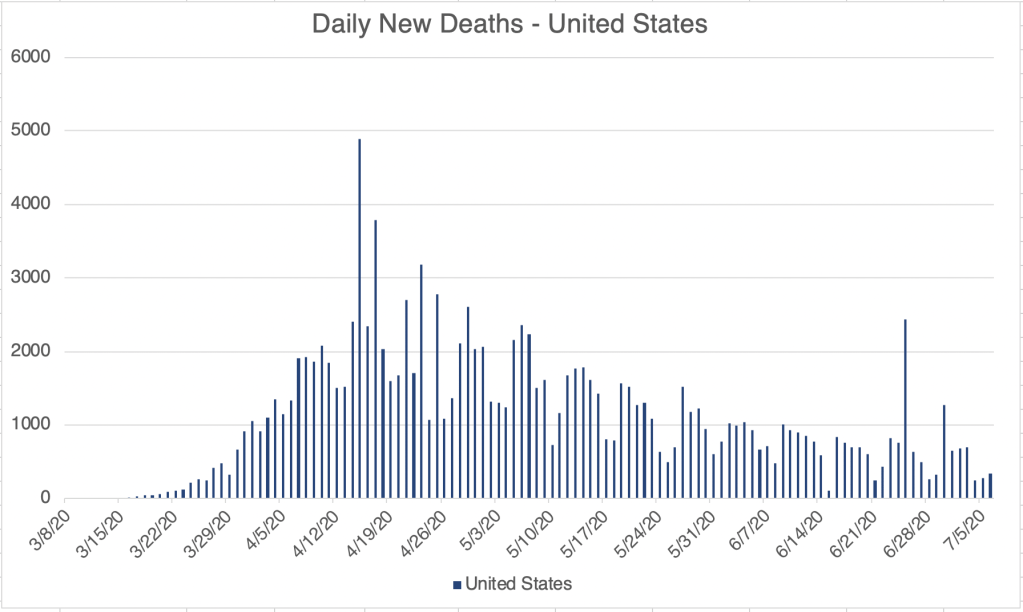
Graph is by me, from data collected from Johns Hopkins University COVID site.
Graph is by me, from data collected from San Diego County Public Health. See also regularly updated slides from SD County.
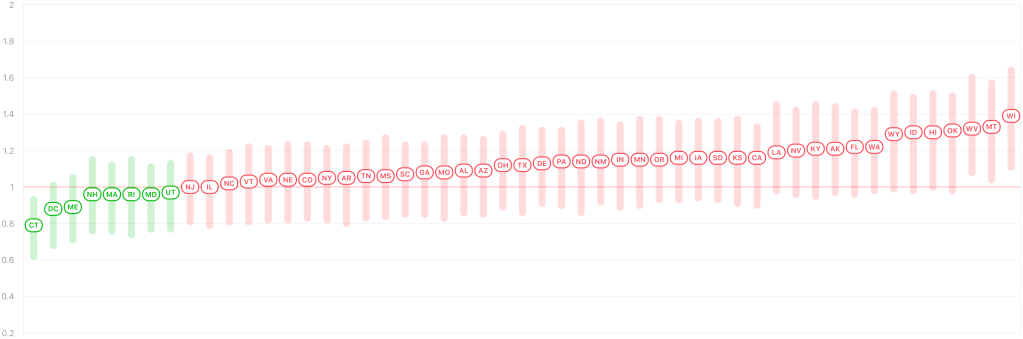
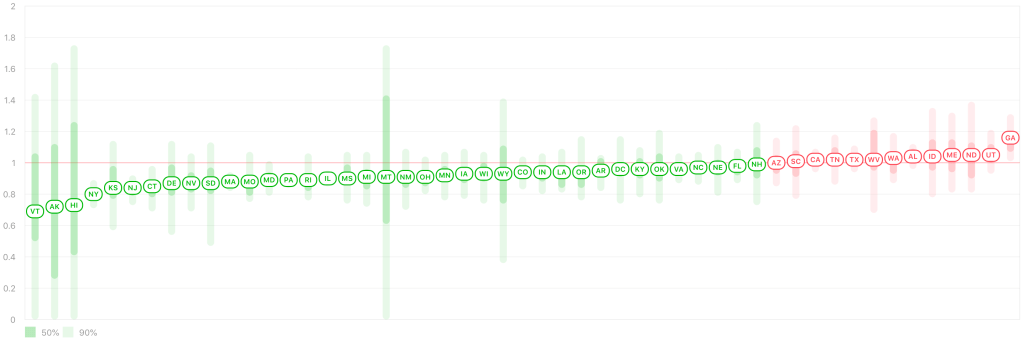
From Rt Live

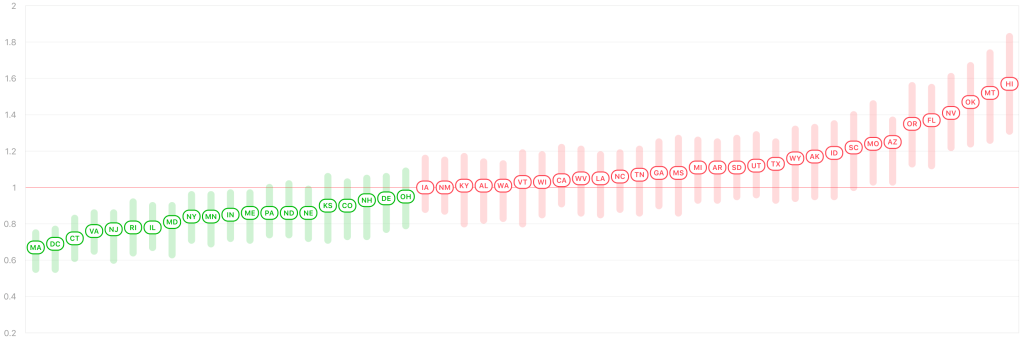
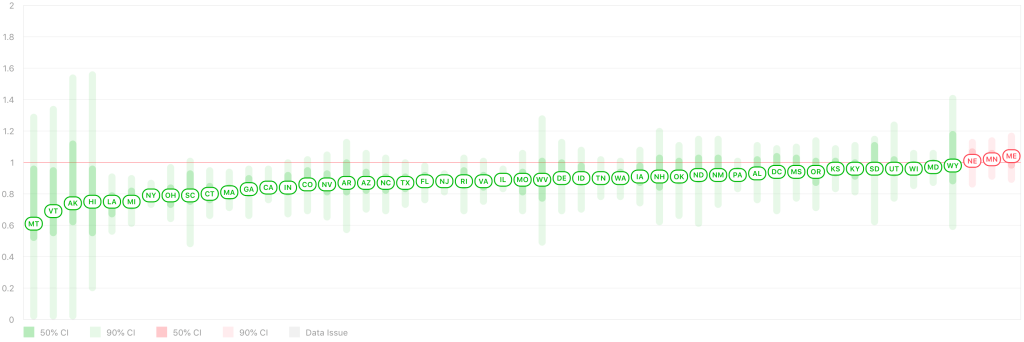
Rt Live is reporting that all but 8 US states or territories have Rt values above 1.0, meaning that the virus is expanding in those states.

I’m going to bring up an issue that I’ve been avoiding talking about for some time. I’ve been avoiding talking about it because it’s not a certainty, and also because the possibility will be scary for some. The reason I feel compelled to talk about it now is that many are having a hard time understanding why I am still so concerned about the virus when the fatality rate is low and dropping, and folks want to get back to normal life. I’m even hearing about young people having COVID parties in which people gather with a sick individual so they can all get infected and be immune from the virus thereafter.

Before I share this, I’ll also say that the medical community is doing a better job treating patients with COVID, and the disease is becoming more survivable. In addition, we now know a lot about how the virus is spread, and if a person wants to remain uninfected, they can do that, while still getting together with friends and family, and still working and getting on with life. You can be reasonably certain you will not get infected if you do the following:

1) Wear a mask or face covering in public. Avoid places with unmasked people.
2) Keep 6 ft away from others.
3) Avoid indoor gatherings, especially ones in which singing or shouting is likely.
4) Small outdoor gatherings are fine, even without masks, if everyone maintains a distance. Have guests bring their own food.
5) While many restaurants are open for limited indoor seating, I personally am still not comfortable eating indoors at a restaurant. I enjoy eating outdoors at restaurants, however.

Antibody Dependent Enhancement: Several years ago, scientists were developing a vaccine against Dengue Fever, a mosquito borne disease which causes debilitating joint pain in patients. Some time after trial vaccination, several vaccinated patients died suddenly of Dengue Fever. This became the most studied example of Antibody Dependent Enhancement (ADE). Normally, for the annual flu let’s say, a person gets infected by the flu, is sick for a few days, and the immune system develops a response by creating antibodies against that specific strain of the flu. If they are exposed again in a month, nothing will happen. If the patient is exposed to a different strain the following year, they may still get sick, but the antibodies they developed the year before may help them have less severe disease and recover more quickly. Part of the immune response is that some immune cells display antibodies on their surface to capture new invaders.

With Dengue and some other viruses, the first stages are normal. A person gets infected and develops a response. If they get re-infected a month later, nothing happens. But if they get infected with a slightly different strain months or years later, instead of being protected, the virus attaches to antibodies displayed on immune cells and uses the antibodies as a site of entry into the immune system. The immune system is quickly infected, and the patient has a more severe disease with the second infection. Some estimates are that disease may be 3-4 x more severe in these patients.

As it turns out, SARS-1, which arose in 2002, and MERS, which has small outbreaks every year, are both Coronaviruses and both appear to be able to use the ADE pathway. This raises the possibility that SARS-2, the current virus, can also use the ADE pathway. This means that a person infected for a second time with a different strain of SARS-2, or any other Coronavirus for that matter, may be at much higher risk for severe disease.

This is why I’m not in favor of pursuing herd immunity as a pathway out of this crisis, because it will prime people for ADE related problems if a similar strain should strike next year.

This is not a new idea. If you search for “ADE” or “Antibody Dependent Enhancement”, you will see many articles, some peer reviewed from respected journals, on the phenomena. Dr. Fauci has even referenced it using the term “enhancement” when talking about vaccine development.

Why haven’t the government public health departments been more open about this? They tend to make statements only based on what they can be reasonably certain of, which is why they have been so slow to react to many aspects of the current crisis.

Again, it’s not certain that ADE will play a role next year. It’s too early to know. I’m informing you of the possibility so you can make wise decisions for you and your family.

More than ever, don’t fear, but be smart,
Erik


A selection of relevant papers:

ADE and it’s potential impact for SARS-2:


ADE in SARS-1:


Overlapping symptoms for SARS, MERS, and SARS-2:


Is COVID-19 receiving ADE from other coronaviruses?


Possible mechanism for ADE:
Case Update: June 30th

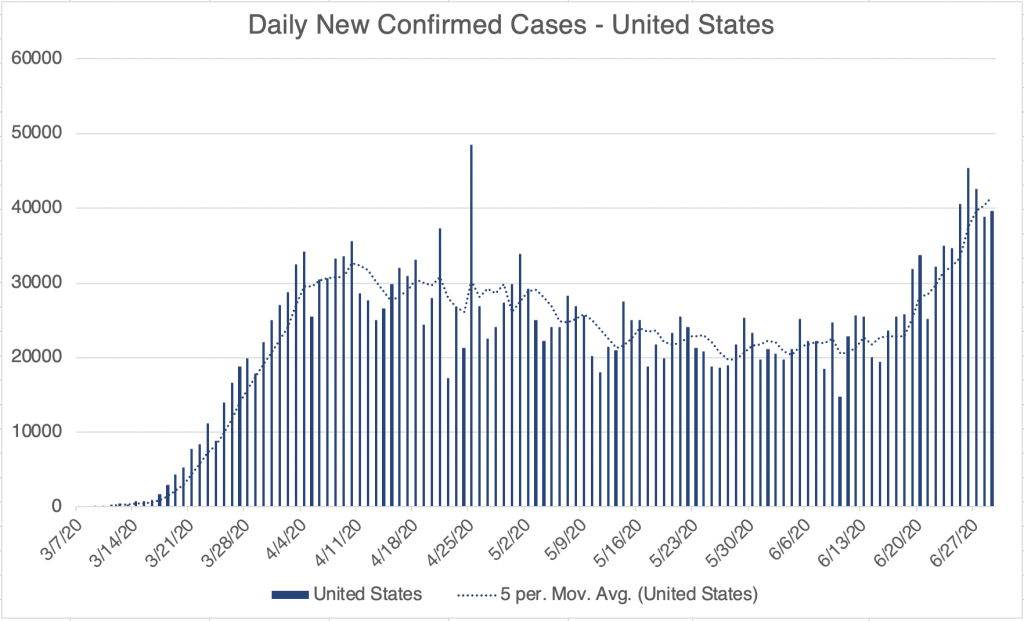
This is a case update. Unfortunately, we are experiencing an explosion of new cases in the US, California, and San Diego County this week, continuing the trend that started a few weeks ago. For all of these regions, this week brought record highs for all three regions. California reached approximately 66k active cases, and San Diego County has doubled it’s active caseload to 4,222 in just the past week.

Graph is by me, from data collected from Johns Hopkins University COVID site.
Active Cases are calculated based on the assumption that all patients with cases confirmed more than 17 days previous have recovered.
Graph is by me, from data collected from San Diego County Public Health. See also regularly updated slides from SD County.
Graph is by me, from data collected from San Diego County Public Health. See also regularly updated slides from SD County. Some data points for Active Cases come from San Diego County Health, while others are calculated.

Why is this happening? Probably for multiple reasons. First, as things re-open, some businesses and individuals are not following guidelines for safe reopening. San Diego County had 7 super-spreader events in the last week, 4 at restaurants, and 1 at a private residence. You may have seen a story in the news this week about a bar in Michigan in which 85 college aged people were infected in a single evening. As you might imagine, they were not wearing masks, and were not practicing social distancing. The recent protests and riots almost certainly have had an impact as well.

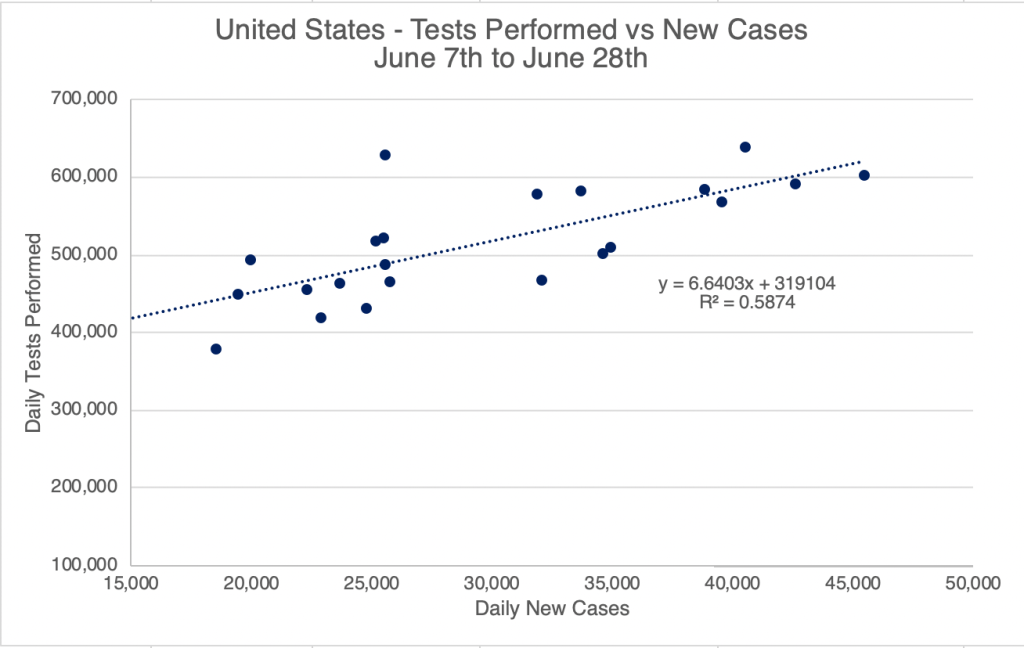
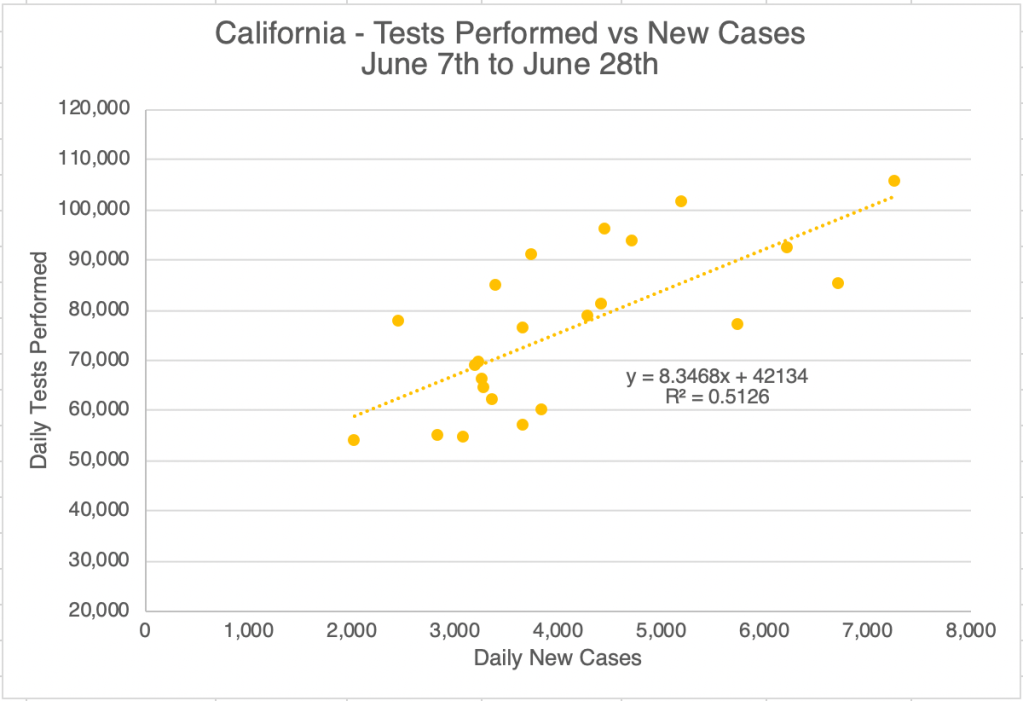
In my May 12 post, I explained how you can tell if testing is having an impact on confirmed cases by graphing daily tests against daily new confirmed cases. In the last few weeks, the R2 number has risen into the 0.5 range for the US and California. An R2 number of 0.95 “proves” correlation, but a number in the 0.5 range suggests some contribution by increased testing. These graphs suggest that increased testing has contributed some of the new cases numbers, but some of the new cases are simply new infections as well.

An R2 number of above 0.95 suggests good correlation, a number of 0.59 suggests that while there may be some contribution from increased testing, much of the increase is real new cases.
An R2 number of above 0.95 suggests good correlation, a number of 0.51 suggests that while there may be some contribution from increased testing, much of the increase is real new cases.

There is some good news. That is that if you are careful and follow the below guidelines, you can be reasonably certain you won’t catch COVID:

1) Wear a mask or face covering in public. Avoid places with unmasked people.
2) Keep 6 ft away from others.
3) Avoid indoor gatherings, especially ones in which singing or shouting is likely.
4) Small outdoor gatherings are fine, even without masks, if everyone maintains a distance. Have guests bring their own food.
5) While many restaurants are open for limited indoor seating, I personally am still not comfortable eating indoors at a restaurant. I enjoy eating outdoors, however.there may be some contribution from increased testing, much of the increase is real new cases.

An epidemic is like a brush fire. When it dies down, we can start to be complacent, but diligence is still required. We are experiencing this new burst of cases because we have let our guard down. Hopefully, we can get things back under control soon.

Maybe take a break. After all the troubling news of the past month, a friend of mine complained that he is feeling depressed and not doing well. While I encourage everyone to follow the news and to be engaged with public life, studies show that over consumption of social media can lead to depression and anxiety. If you feel depressed, or your blood pressure is high, or you’ve been ranted to your wife more than she would like (I know someone like that), you may benefit from a news and/or social media fast. Consider taking a day or more off a week to let yourself calm down and get back to normal. In our information age, we can receive all the bad news of the world at all times, and we aren’t designed to carry that burden.

Don’t fear, but be smart.
Erik

Case Update: June 23rd

This is a Coronavirus case update. New confirmed cases continue to climb for all three regions that I monitor closely, the US, California, and San Diego County. Calculated active cases in California are now at approximately 50,000 active cases, up from 20,000 at the height of the first peak in early April. Los Angeles County continues to dominate the caseload, with 51% of total confirmed cases in LA County.

Graph is by me, from data collected from Johns Hopkins University COVID site.
Active Cases are calculated based on the assumption that all patients with cases confirmed more than 17 days previous have recovered.
Graph is by me, from data collected from San Diego County Public Health. See also regularly updated slides from SD County.

Rt Live reports that 29 of 51 listed US states and territories have an Rt of above 1.0, suggesting that the virus is spreading in those states.

From Rt Live.

Internationally, Brazil just crossed the 1 million confirmed case mark, and is #2 in total confirmed cases behind the US. Brazil’s new daily cases may have hit it’s peak, however, so new cases may finally be slowing down. Russia and India are next in total cases.

Daily new confirmed cases for Brazil, showing possible peak. Graph is from Johns Hopkins University COVID site.

Over the past week, San Diego County Public Health has reported several small outbreaks in restaurants and businesses. As we re-open, it will continue to be important to wear masks and social distance while in public.

Don’t fear, but be smart!
Erik

Case Update: June 17th

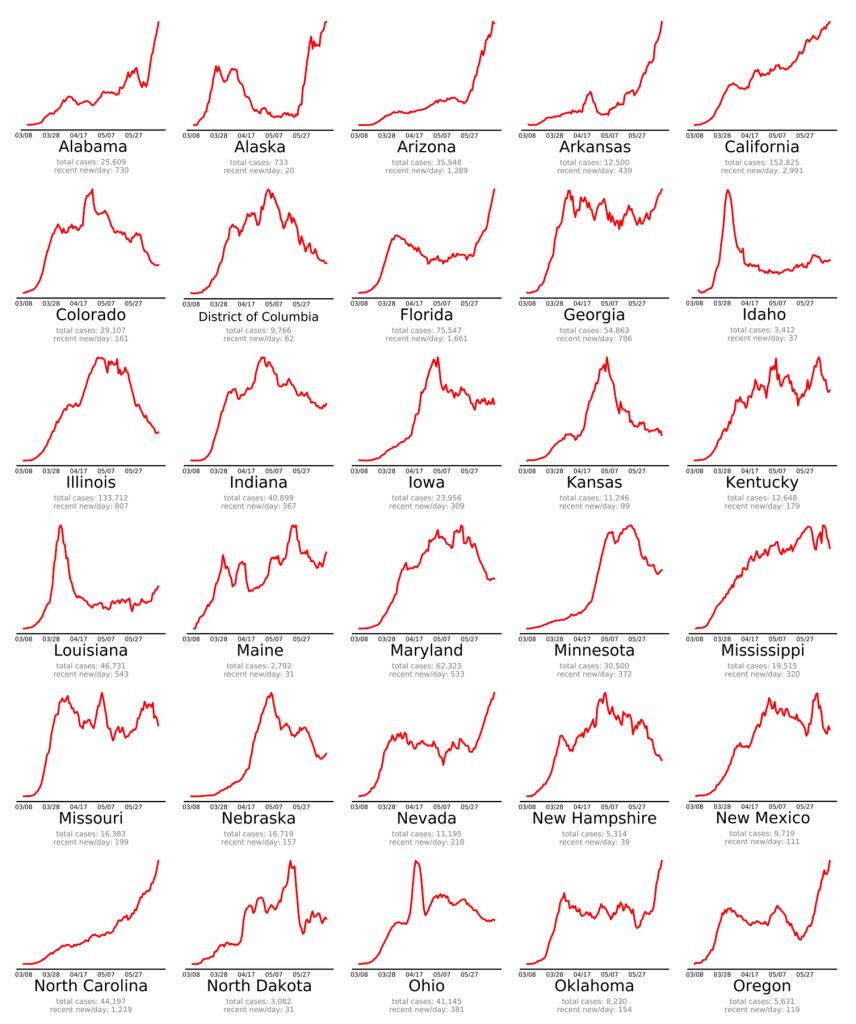
This is a case update.  New confirmed cases are starting to trend upward for the US again for the first time since about April 9.  In 19 US states, the Rt number is higher than 1.0, suggesting that the virus is spreading in these states.  On endcoronavirus.org, you can clearly see recent spikes of new cases in some states, and in many countries.

From RT Live.
From endcoronavirus.org.
Graph is by me, from data collected from Johns Hopkins University COVID site.

In California, the number daily new cases continues to accelerate.  San Diego has started to go up too.  San Diego County has started to publish the number of recovered patients.  My graph of cases in SD County now includes active cases, taking recovered people into account. Some of these points of data on my graph are given by SD County, the others are calculated by me based on the data points.  Looking carefully at the SD County data, the number of recovered people is approximately the number of total cases from 17 days previous.  The suggestion is that it takes approximately 17 days to recover after being confirmed as a COVID case, so I’ve made a similar calculation for California.  Just to be clear, in my graph of active cases in California, the data points are based on assumptions about recovery time, not actual data.

Graph is by me, from data collected from Johns Hopkins University COVID site.
Graph is by me, from data collected from San Diego County Public Health. Numbers from recovered patients are from a regularly updated slide presentation.

For San Diego, active cases have been hovering around 2,000 for several weeks, without much change, but for an increase in the last few days.  For California, we’ve seen a steady trend upward in active cases from 20,000 in early April, to 40,000 cases today.  There are of course lots of potential reasons for these increases, from gradual re-opening to the protests and riots stemming from the George Floyd incident.  I was once optimistic that the first wave of cases would be over this Summer, but new trends have called this into question.  I’m now feeling totally unable to predict how things will go.

Graph is by me, from data collected from San Diego County Public Health. Numbers for recovered patients are from a regularly updated slide presentation.
Graph is by me, from data collected from Johns Hopkins University COVID site.
Active Cases assumes that those cases confirmed 17 or more days ago have recovered.

I heard a radio commentator talking about a recent study that I haven’t been able to find.  The study said that while Social Distancing account for maybe a 50% drop in new cases, the lockdown accounted for only a 5% additional drop.  Given the economic and social cost of the lockdown, the study suggested they were not on the whole worth the cost.  If you’ve seen the actual study, please post it in the comments!

So please continue to social distance and wear your masks in public!  But it’s time to figure out how we can get the economy running again!  We have big problems to solve, time to get to work!

Don’t fear, but be smart,
Erik

Case Update: June 9th

Here’s the weekly update on the virus. As I predicted in my June 2nd post, we’ve started to see an increase in cases, at least for areas that I closely monitor. For the United States as a whole, the increase has been subtle, really just a flattening of a steady downward trend. For California and especially San Diego County, there has been a pronounced uptick in cases during the last week. The City of San Diego had some protests last weekend, but not nearly as much as in other cities like Minneapolis, NYC and LA. If the pattern for San Diego holds for other cities, they will experience more severe increases in cases. Oddly, many in the media strongly discouraged protests in favor of re-opening, but are seemingly promoting protests about police brutality without regard to precautions like mask wearing. Even the WHO is encouraging mass protests. Of course there are good reasons to attend a peaceful protest. If you go to a protest, please wear a mask. Of course, I have to discourage you from attending a riot.

I do have to point out that there are many factors that contribute to these increases, such as the ongoing re-opening, and no single factor can be blamed.

Graph is by me, from data is collected from Johns Hopkins University COVID site.

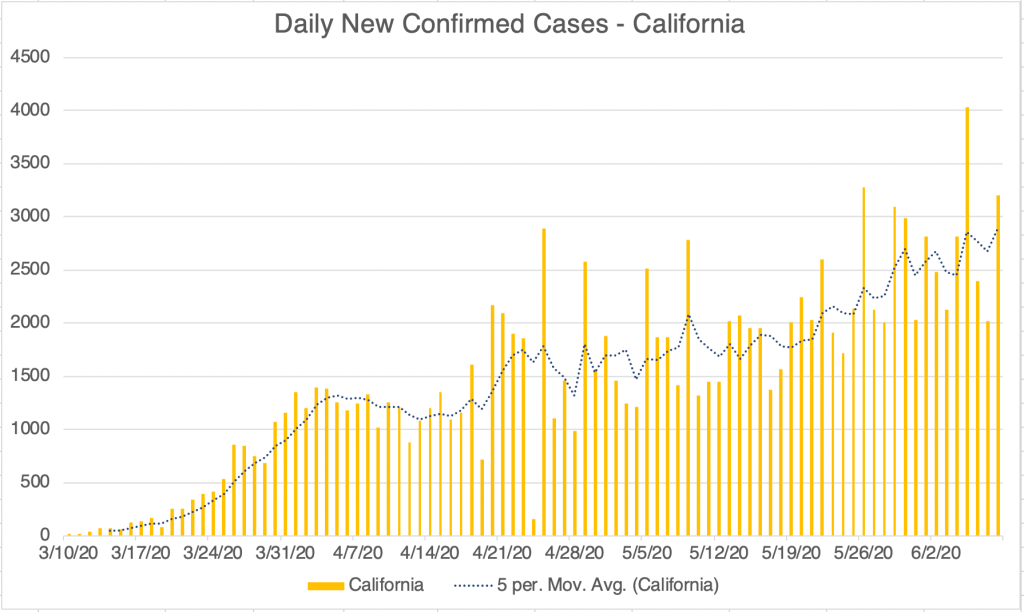
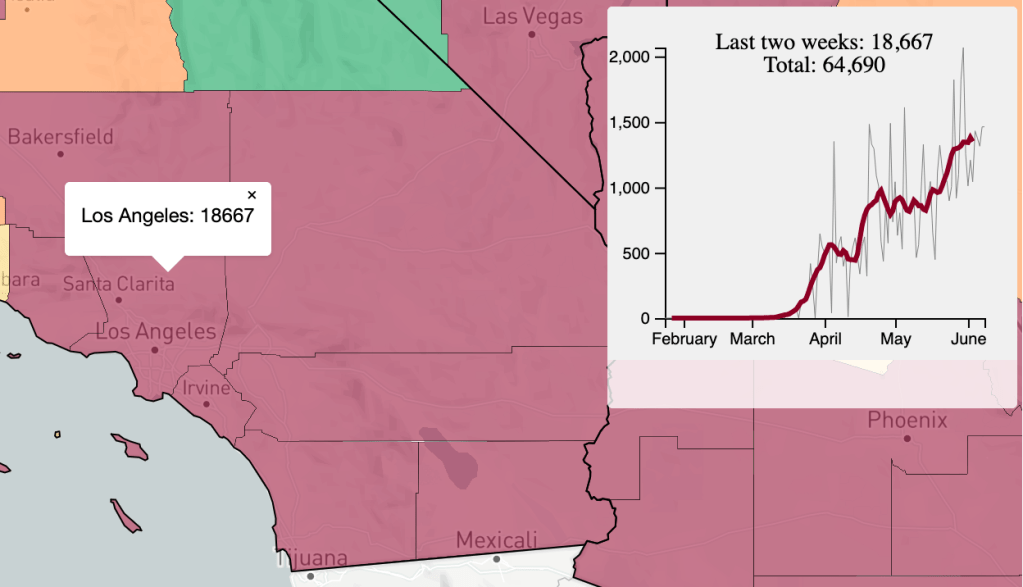
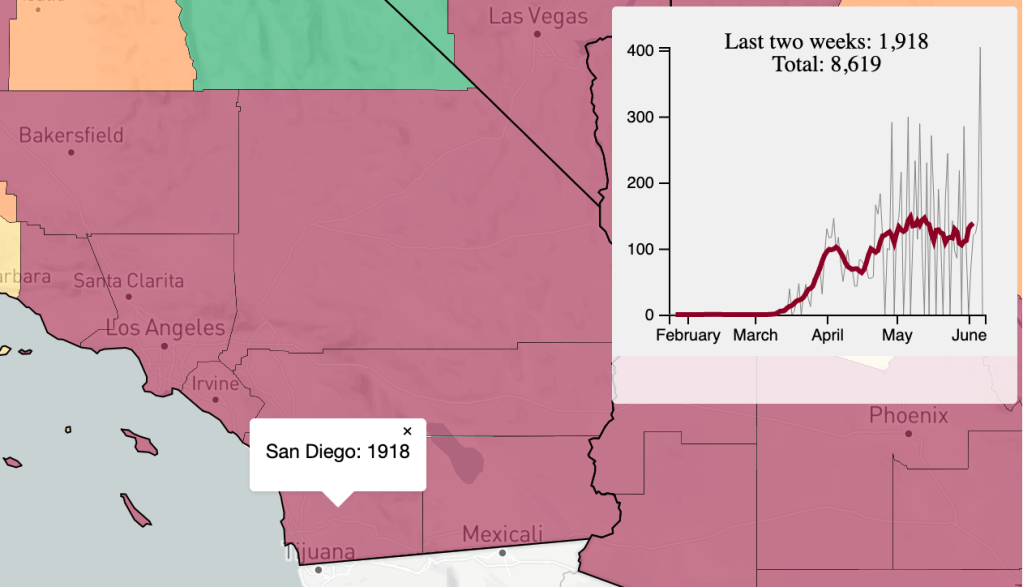
Endcoronavirus.org has introduced a new feature in the last week, a county level map showing the recent change in new cases. Clicking on a county will give you a plot of new cases for that county. High caseloads for urban areas is a well known pattern, but I’ve also noticed hot-spots of cases in certain rural areas. A new article in the Wall Street Journal may suggest a reason. Large families living in the same house may present an opportunity for rapid spread should someone be infected who lives there. As we discussed on May 27th, the virus spreads much more quickly in indoor venues than it does outside. This suggests that if you have a large family, members will need to be extra cautious to not bring virus in from the outside.

From endcoronavirus.org Counties map.

Don’t fear, but be smart,
Erik

Case Update: June 2nd, A Discouraging Week

Well, this has been a very discouraging weekend for me and I’m sure for many of you. The unjust killing of George Floyd as well as the riots that were fomented by far left elements have taken the spot light from the Coronavirus of course.

It has been a very rough week, and I’m afraid I don’t have an encouraging update for you. Nationally, the daily new cases continues to go down. However, according to Rt Live, 13 states currently have Rt values above 1.0, including California, meaning that the virus is now spreading again in those states. Daily new cases in California are continuing to increase in California, and in fact the increase has been accelerated since restaurants and other businesses were reopened on the 21st.

Rt values for various US States and territories. 13 states currently have Rt values above 1.0, meaning that virus is now increasing in those states.

San Diego is nearly flat in new case numbers, but zooming in on recent new confirmed case numbers shows that the County is actually improving, even after re-opening, so we can be glad for that at least, if you live in SD County.

San Diego County new confirmed cases since April 23, 2020. Dotted trendline highlights a trend of decreasing numbers.

For those of you in Montana, there was a small cluster of new cases this week which made the Rt value go up above 1.0 for a brief time. This is because the Rt value reflects a change in numbers, and since the numbers were so low in Montana, any cluster will make this number rise. After a few days, the Rt value for Montana is back below 1, and Montana continues to do well. But this illustrates how important it is to be diligent, even in a state that is generally doing well.

Rioting has of course broken out in many cities in the US. Starting as peaceful protests, many were hijacked by far left elements that wanted to cause wide-spread chaos. Among other damage, rioters and looters were often in close contact without masks on. And yes, I know is sounds a little comical to be worried about that when watching scenes of small businesses being destroyed. Look for Coronavirus case numbers to rise sharply later this week. I’ll keep you posted.

Pray for our nation!
Erik

Case Update: May 26th

Today I have a weekly update on cases, followed by some speculation on what it means.  As we’ve seen before, the United States has a slowly diminishing daily new case load for confirmed cases.  Death rates for the US, perhaps a better measure than confirmed cases, are also slowly diminishing.  Several sites seem to be accepting the data from Sutton et al (Universal Screening for SARS-CoV-2in Women Admitted for Delivery, NEJM, April 22, 2020) to estimate that actual cases is 8 times that of confirmed cases. California continues to have a slowly increasing caseload.

Data is collected from Johns Hopkins University at approximately 9:30 pm nightly.
Data is collected from Johns Hopkins University at approximately 9:30 pm nightly. Note the strong “weekend effect.”

According to the John Hopkins University COVID site, LA County accounts for a full 48% of cases in California, with Sierra and Trinity Counties, in the East and North having just 1 case each.  Cases are definitely centered in urban areas, mostly in Southern California.  Daily death number in California appear to be perhaps flat.  Interestingly, with all of these graphs, California daily deaths in particular, there is a clear weekend effect, with a weekly low in numbers on Sunday or Monday of each week.  So when you look at the daily caseload for the US, with it’s jagged Sierra-like peaks, you’ll know it’s because health-care workers take the weekend off too, and reporting is being done during the week! San Diego’s numbers continue to be relatively flat.

Data is collected from San Diego County Public Health at approximately 9:30 pm nightly.

What we would like to see now is a lowering in the number of active cases.  Unfortunately, this highlights a problem in all of this, how health departments define a “recovered” case.  San Diego has just begun to report recovered cases.  The reported numbers suggest that cases resolve in about 16 days after confirmation on average.  For the US, reported recoveries suggest that patients recover in 50 days.  California doesn’t report recoveries at all. Each entity defines a recovered case differently, so it will be difficult for us in the public to tell how many have recovered.

Data is collected from Johns Hopkins University at approximately 9:30 pm nightly. https://coronavirus.jhu.edu/map.html
Reported recovered patients suggest recovery after 50 days after confirmation.
Data is collected from San Diego Public Health at approximately 9:30 pm nightly. Active cases after 5/15 are based on data released by San Diego County. Points previous to 5/15 are calculated based on the assumption that recovery time after detection is 16 days.
Reported recovered patients suggest recovery after 16 days after confirmation.

Reports from last week regarding the possible failure of lockdowns to bring numbers down are causing a lot of speculation on line as to the best way to improve.  Many Western countries are struggling to reduce the number of new cases, and many countries are only now having their initial surge in cases (see my May 24th post).

In the US, several states are creeping back toward an R0 of 1.0 after re-opening.  We definitely want to stay below 1.0, as this indicates a slowly vanishing caseload. Texas was doing very well for a long time, but the R0 there is above 1.0 for the first time in quite a while.  Cases are predominantly in urban areas, Houston, Dallas, and Austin.

Information is from Rt Live.

A lot of studies are being done on the best approach.  Japan is of particular interest because after an initial very small peak, they had a much larger peak starting in late March.  They didn’t have the massive testing of So. Korea, nor did they have a strict lockdown.  But they got things back under control quickly, and they have a very low daily caseload now, despite the VERY high population density of cities like Tokyo.  So far, people are speculating that they are doing well because it’s culturally acceptable there to wear masks on a regular basis, and others are just calling it a mystery.  I’m sure researchers will be taking a close look at Japan.

All the best to you and your family! 

Don’t fear, but be smart,

Erik

Sutton et al (Universal Screening for SARS-CoV-2in Women Admitted for Delivery, NEJM, April 22, 2020):

JP Morgan Study on Lockdowns, The Moral Matrix and Pandemic, and the Viral Upsurge in the Southern Hemisphere

Today I’m going to discuss the JP Morgan study on transmission (among other things), how the Moral Matrix effects how people see the fight against the virus, and the boom stage in many Southern Hemisphere countries.

JP Morgan has produced a study suggesting among other things that lockdowns are ineffective in fighting Coronavirus (see also a summary from Daily Mail).  The reasoning for this is primarily that transmission is most common in households if a member becomes infected. 

Frankly, when I think about anti-coronavirus efforts, I have tended to lump lockdowns and social distancing together, especially since many use these terms interchangeably.  Notably, the study separates these 2 concepts and suggests that will social distancing (staying a distance away from people in public) may be valuable, lockdowns (staying in your home) is not. 

You might say there have been 2 primary models for dealing with the pandemic in the last month after we’ve flattened the curve, but have not brought the numbers down, at least not in the US.  I’ll call those models the Lockdown and the Re-opening models.  Some want to continue the lockdowns to keep everyone safe from the virus, others want to re-open right away without restrictions.  For several weeks, I have been gravitating toward a third Adaptive model.  Of course, there can be many flavors of this model.  Personally, I think masks, even bad ones, are far better than nothing, especially when worn by everyone, and can help us get back out of our houses and help us re-start the economy with reasonable safety.  So I’m very open to the idea that the lockdowns have not been beneficial.  Some of you will disagree.

The JP Morgan study is at odds with the endcoronavirus.org study, which recommends brief, very strict lockdowns.  It could actually be that these 2 studies actually agree, depending on the time frame you’re talking about.  I do think the lockdown was very helpful in the initial “boom” stage of the epidemic here in the US, but may have lost its usefulness later.

The Moral Matrix: ZDoggMD is a physician and medical YouTuber with a very silly screen name, but who posted VERY interesting video on how different people see the pandemic we are all facing.  Using Jonathan Haidt’s work on the Moral Matrix, he talks about how different people’s moral framework shapes how we are viewing different efforts to address the issue.  I was aware of Haidt’s work, but not had yet applied it to the pandemic in my mind.  As someone who is sometimes exasperated with people who disagree with me (as they are with me I’m sure), this video is helping me remember to see their point of view.  If you’re exasperated with your friends or family, I HIGHLY recommend you watch this video.

Upsurge in the Southern Hemisphere: Lastly, I just want to mention that many countries which have been relatively little effected until now, are now experiencing a big upsurge in cases.  These countries include Russia, Brazil, and Mexico, and many are in the Southern Hemisphere, which is in the late Autumn months right now.  Let’s hope they are able to get things under control quickly.

Don’t fear, but be smart!

Erik

PS. We went hiking in nearby Calaveras Park today for the first time in months, without our masks. There were a lot of people on the trail, and most were well behaved. When I can’t avoid someone on a narrow trail, I use an old SCUBA diving trick for ascending without getting the bends. Just close your mouth and blow slowly out of your nose as you pass someone. You’ll gently move any virus away from your nose! To maintain my friendliness, I greet people early, with plenty of time to start this little maneuver!

Case Update: May 19th, Some California Counties Re-open Further, San Diego Recovered Patients

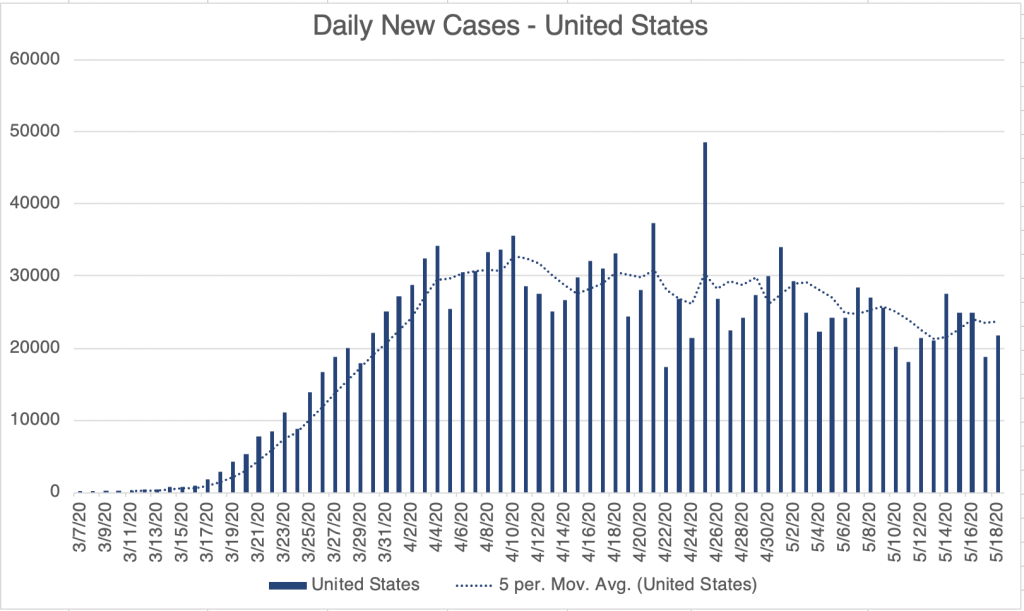
This is a case update for the previous week.  As we’ve seen before, new cases in the US are slowly trending downward (currently around 21k confirmed cases per day), slowly trending upward in California (around 2k confirmed cases per day), and flat in San Diego County (around 125 confirmed cases per day).  As we discussed from statistics last week (May 12th post), many of these are likely real cases, and not just because of additional testing.

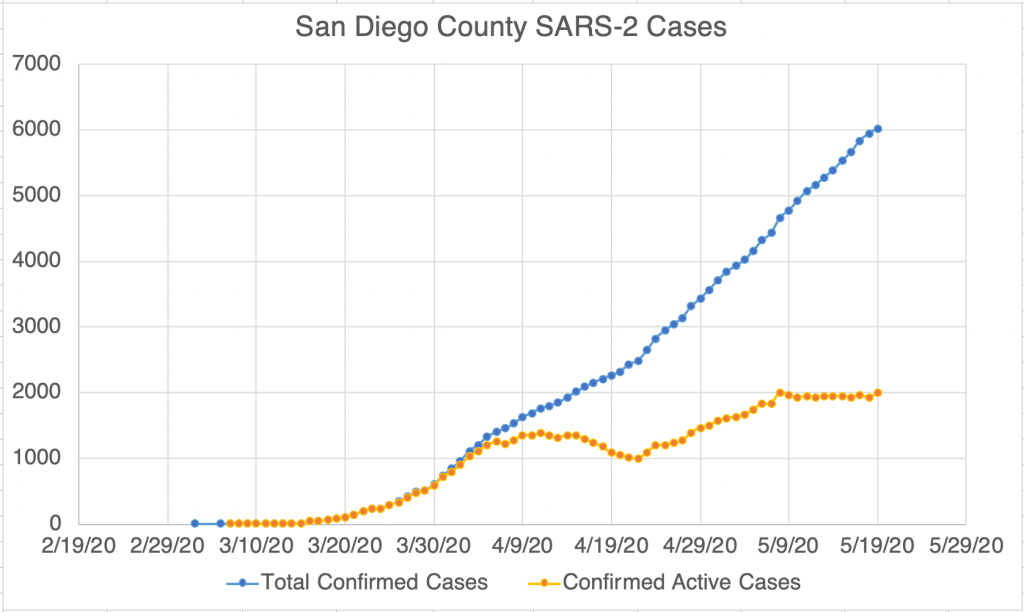
Active cases after 5/15 are based on data released by San Diego County. Points previous to 5/15 are calculated based on the assumption that recovery time after detection is 16 days.

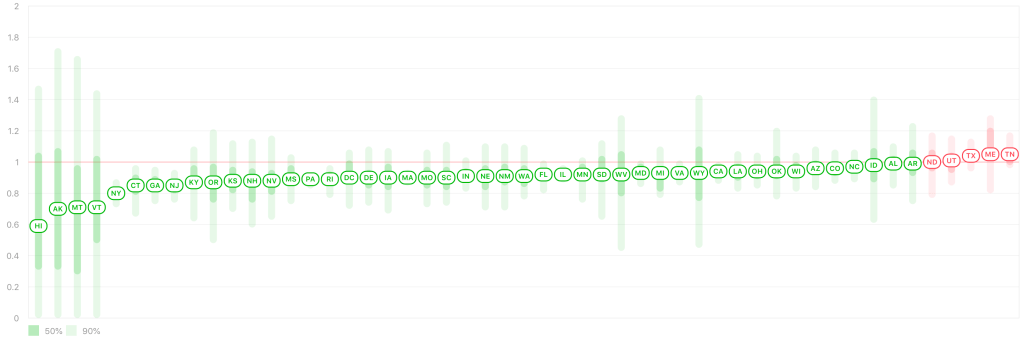
Rt Live reports that all but 2 states have an Rt value below 1.0, meaning that the virus is slowly disappearing in that state.  You may notice if you look on that site, however, that several states, including California, still have slowly upward trending cases, even though they have an Rt value below 1.0.  This appears to me to be a discrepancy.  Possible explanations for this may be that the Rt Live’s algorithm is too generous and miscalculates Rt for some states, or that the Rt value needs to be much lower than 1 for a downward trend to be seen.  We can certainly hope that we will see improvement in these states soon.

Some counties in California will be able to move further into Step 2 of re-opening (Step 2b?). Unfortunately for many of us, none of these counties are in Southern California!

My friend who works at San Diego County Public Health, Brit Colanter, has posted an update slide deck that the County has released, and will update regularly.  The county is continuing to have more testing available to the public and is now releasing the number of recovered COVID patients.  As of last night, total confirmed cases in SD is 5946, and current active cases is 1926.  So more than half of our confirmed cases have recovered!  That’s great news!

As we continue into recovery and more businesses open, please continue to wear masks in public, and continue to distance whenever possible!  The CDC was slow to recommend masks, and it’s true that masks are not 100% effective, but if everyone is wearing masks that are 50% effective, this will go a long way toward minimizing transmission. See my May 5th post for more info and for mask designs! I’m a big fan of wearing masks in public, and it may be the key to opening more businesses.

The more we keep new cases low, the faster we can continue the re-opening process!

Don’t fear, but be smart!

Erik

Rt Live

California, Resilience Roadmap

County by county guidance

San Diego County Update Slides

Re-opening, How Many New Cases?, endcorona.org Compares Responses, Viral Spread

I have a variety of resources to share with you today. 

Re-opening: First, after many states have started to re-open, Rt Live is showing that all but 3 states have an Rt value below 1. This means that for most states, each infected person is passing the virus to less than 1 other person, and the virus is slowly disappearing in that state.  The states with an Rt above 1 are Minnesota, Maine, and Nebraska.  After a poor initial response, I’m happy to say that New York State is doing very well now, and daily new cases are low in New York. In California, my home state, the number of new cases is flat, approximately 1700 cases per day since the middle of April.

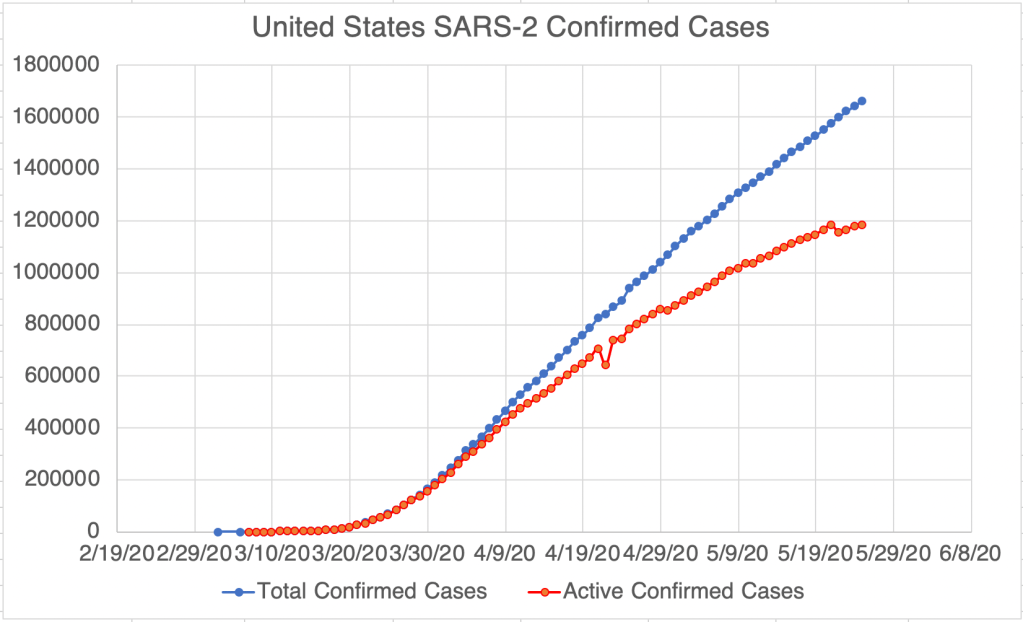
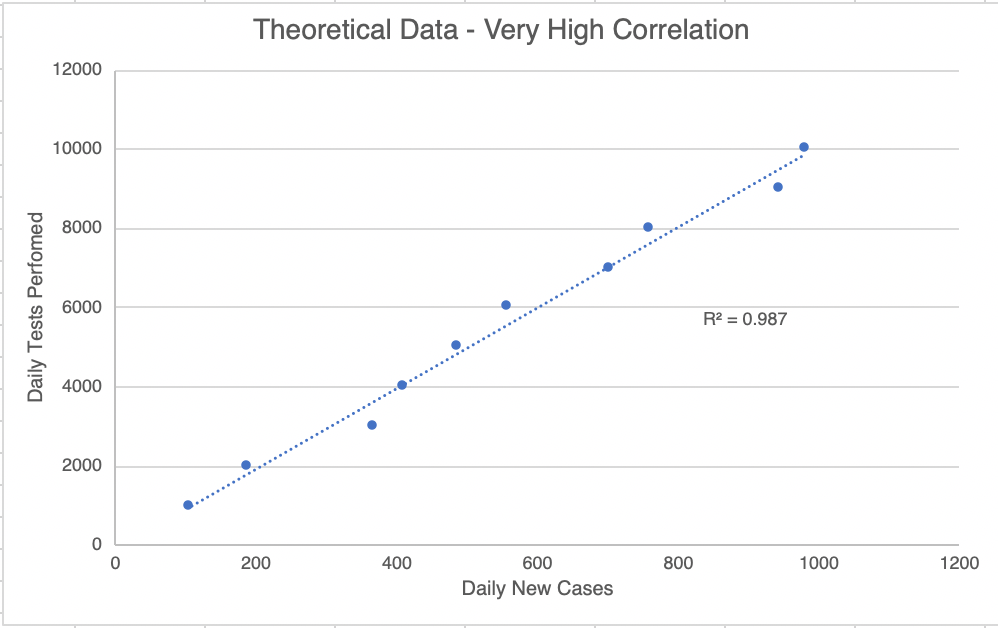
How many real new cases?  This is going to be a little mathy!  I told you I was going to start tracking the number of tests, and I have been doing that since April 27th.  This will help us know how many of the new cases are just because of more testing, and how many are actual new cases.  I’ve plotted the new cases against the new tests.  For each day, a point comparing the new cases and new tests is shown. If new testing matters, then a day with a high number of tests will also have a high number of new cases. To find out if this pairing exists, we can do a statistical test called the R2 test (pronounced “R squared”, also called the correlation coefficient).  This test creates a best fit line with the data and that creates an R2 value.  This value is a measure of how well the 2 parameters (new tests and new cases) are correlated.  I show a hypothetical graph in which the 2 sets of data are well correlated.  A perfect correlation will have a score of 1.0, while a set of data with no correlation at all will get a score of 0.0.  For scientists (at least the ones in diagnostics, like me) a correlation is considered “true” if the R2 value is above 0.95.  You could also say that the correlation is 95% likely to be true.

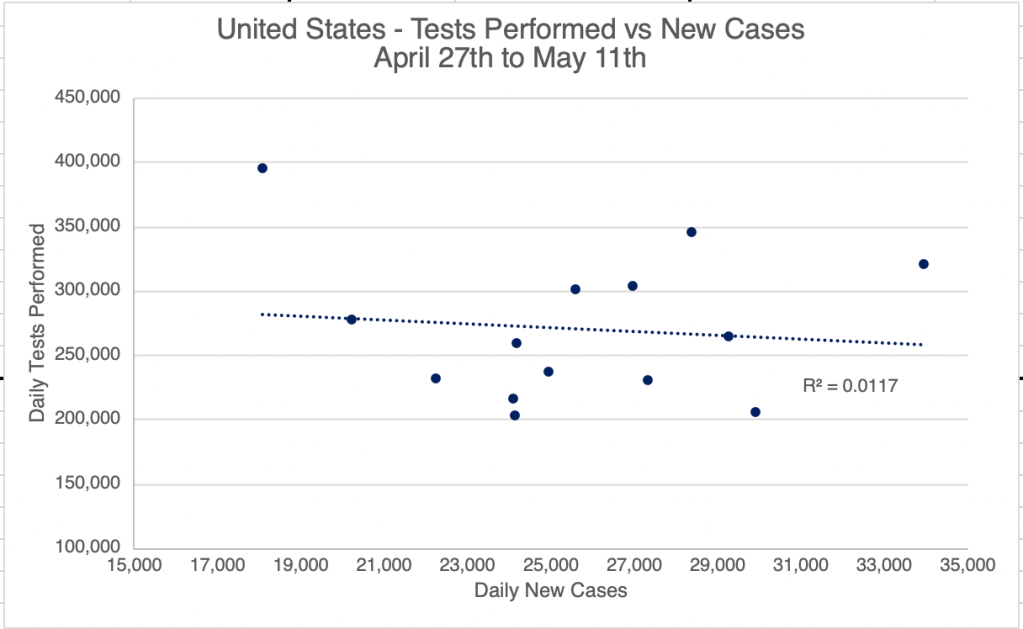
Now on to our data. I started plotting on April 27th.  5 days later, the graph for the United States got an R2 value of 0.6559.  This suggests that new cases and new tests are 66% likely to be correlated for this time period.  In real world terms, this probably means that some new cases are because of new testing, but some aren’t.

Interestingly, as of yesterday, a graph like this for the US gets an R2 value of just 0.0117.  This is very low and suggests that there is now no correlation between new testing, and new cases.  This means that new cases we see now are probably “real” new cases, and not just pre-existing ones that are just being found because of new testing.  For California, the correlation between new cases and new testing was never very high.  Right now, the R2 value is only 0.0039 for California, suggesting that most new cases discovered are “real” new cases.  What this means going forward is that we probably have enough testing now to locate new cases.  As we go forward, I expect we will start to see a steeper decline is new cases.

Good news!  This good news comes with a warning, however!  Those living in the West will easily understand a comparison to a brush fire.  Right now, we are in the “containment” stage.  We have the fire surrounded, and were at the beginning of the end, but if we walk away now, the fire will start to spread again.  We need to stay on task and keep fighting the fire!  I am all for re-opening, but we need to remain diligent.  Wear a mask when you go out into public, and continue to keep your distance from others!  If your workplace re-opens, you will probably want to wear a mask, wash your hands frequently, and sterilize your workspace often. I am probably going to start traveling for work again soon, and I’m very glad that everyone will be wearing a mask on the plane!

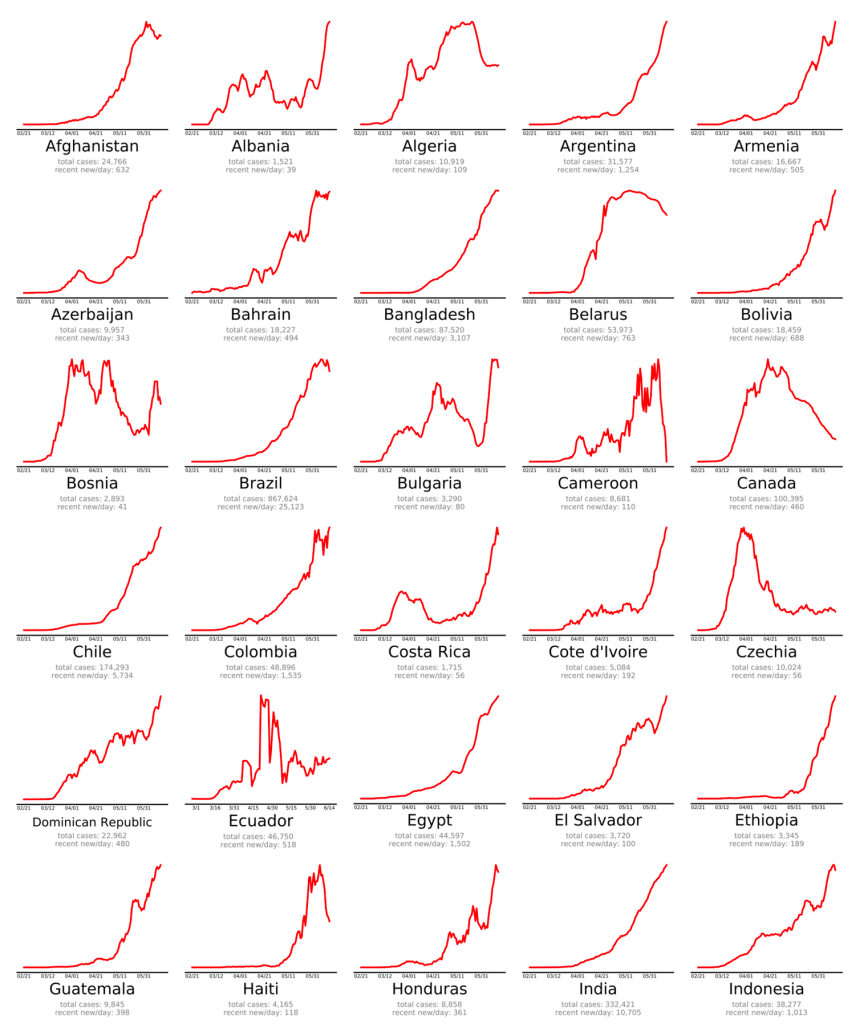
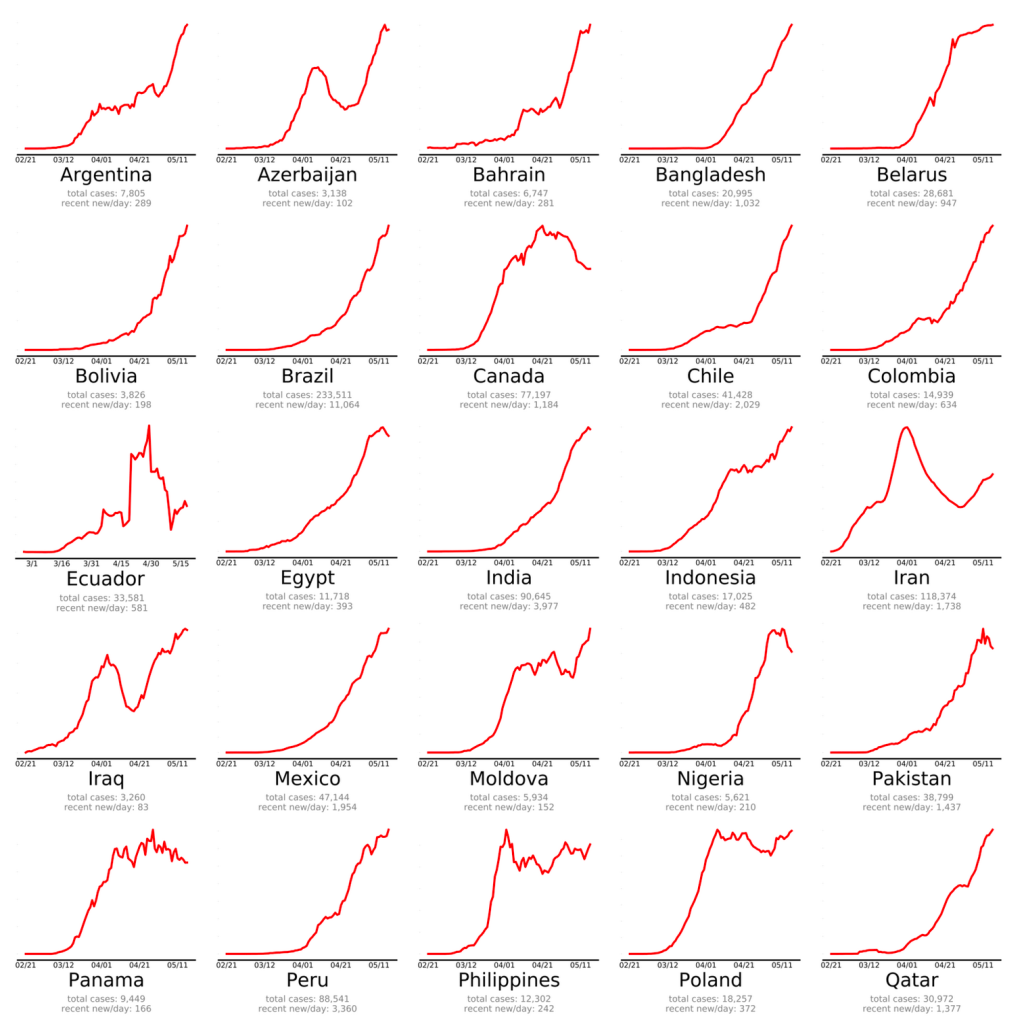
Endcorona.org compares responses: I discovered a new website the other day, endcorona.org, from the New England Complex Systems Institute.  The group compares the responses and results from different countries.  First, “green” countries responded very well, and were able to get the virus under control quickly.  Aside from the good response, I also notice that most of these countries have relatively small populations.  You may notice that China also appears on this list.  Most experts agree that the data coming from China is not reliable, and they probably have many more cases than they are reporting. After intermediate cases in yellow are countries in red that need more action.  This includes the US.  If you’ve been reading my posts, you’ll recognize the “flat” curve of the US.  Yes, we’ve flattened the curve, but we haven’t been able to knock down our case load yet.  Other countries with similar flat curves include Canada, Finland, Indonesia, Panama, Poland, Sweden, and the UK. Other countries had low cases at first, but are now experiencing explosive growth in new cases, including Brazil, Mexico, and Russia.

After analyzing the responses of these countries, endcorona.org recommendations include the following, many of which you’ll recognize:

  1. Lots of testing to identify new cases.
  2. Isolating infected individuals, even from family members!
  3. Strict lockdowns.  The stricter the lockdown, the shorter it will be.
  4. Travel restrictions, even within the same country.
  5. Adequate health care capacity.
  6. Safe practices for essential services.
  7. Masks in public for everyone.

Viral spread: Erin Bromage, an Associate Professor of Biology at U Mass Dartmouth, has a very nice article on his blog describing how the virus spreads. It is well written for non-scientists and has lots of links to original research.  The take home lesson is that the virus spreads particularly well in-doors.  In addition, cough, sneezing, and to a lesser degree shouting, singing, and even talking are all risk factors in spreading virus.

That’s all for now!

Don’t fear, but be smart!

Erik